Get email alerts on the Land Use topic
No spam. Unsubscribe anytime.
Morrow County adopts first reading of broad zoning code update, keeps data centers as allowed use under stricter site review
Summary
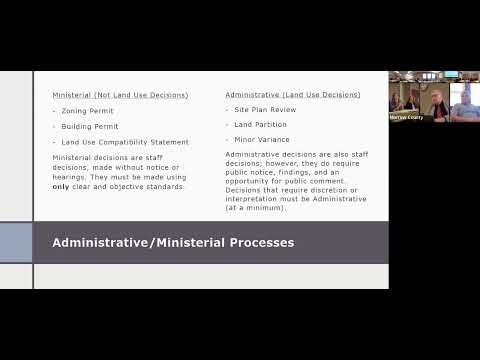
At a public hearing, Morrow County commissioners approved first reading of Ordinance 2024‑06, a package of zoning code amendments that clarifies ministerial vs. administrative reviews, standardizes timelines (14/14), strengthens objective standards and requires site‑level review for high‑impact industrial uses including data centers; staff will refine traffic‑mitigation and SAI rezoning language before second reading.
Morrow County Board of Commissioners held a public hearing on proposed zoning code amendments (AZ‑124.24) and voted to adopt first reading of Ordinance 2024‑06 with staff‑directed edits to clarify review pathways and add stronger, objective site standards for industrial development, including data centers. The board’s action keeps data centers as an allowed use but routes larger or higher‑impact proposals through an administrative site‑plan review (with the option to refer to the planning commission), and asks staff to incorporate targeted language on traffic mitigation and development‑agreement options.
The package updates definitions and reorganizes review types so that ‘‘ministerial’’ (clear‑and‑objective) permits remain separate from ‘‘administrative’’ site‑plan reviews and from quasi‑judicial conditional‑use permits. Staff told the board the revisions grew from a year of work, multiple planning‑commission sessions and consultations with developers and counsel aimed at reducing subjective criteria in zoning permits and aligning county practice with state law. ‘‘We’re trying to make the code abundantly clear,’’ staff said during the presentation.
Traffic impacts were the central practical concern in the discussion. Staff and a county land‑use attorney noted objective triggers in the draft—such as a traffic threshold (commonly cited in the hearing as 400 average daily trips)—that would push an application into the more robust administrative review that includes public notice, a comment period and findings. Legal consultant Dan Kearns said larger data‑center campuses ‘‘are inherently urban in their scale and intensity’’ and often generate high trip counts and infrastructure demands that warrant discretionary review and mitigation.
Representatives of Amazon Web Services (AWS) addressed the board and urged adoption of a ‘‘consensus’’ draft that keeps data centers as an outright allowed use subject to site‑plan review while adding detailed standards. AWS senior representative David (Dave) Domino said the company has made ‘‘capital investments and operating investments’’ regionally and, speaking to local fiscal impact, stated the company paid about "$33,000,000 in taxes in 2022" in the county. AWS asked the board to authorize staff to develop a framework for a multi‑project development agreement to address cumulative traffic impacts across multiple campuses.
Commissioners pressed staff on several points: why data centers were characterized as ‘‘urban’’ uses; how small data centers would be treated; and whether the county’s comprehensive plan and transport standards were being fully accounted for. One commissioner urged a broader update of the county’s economic element to reflect recent large‑scale industrial interest. Staff agreed to bring more precise language and to work with public works on a development‑agreement model if the board wants a tool for comprehensive mitigation rather than piecemeal intersection fixes.
The board voted on a motion to adopt the amendment package as a first reading with the described changes (including AWS‑proposed edits to sections of the site‑plan criteria related to traffic mitigation and a process to allow planning‑commission hearings when appropriate). The motion carried on a voice vote; roll‑call tallies were not provided in the hearing record. Staff said a revised ordinance will be returned for second reading in two weeks and that the written record will remain open for additional materials until that time.
Next steps: staff will fold the edits discussed at the hearing into the ordinance language, prepare any materials needed to evaluate a development‑agreement approach to cumulative traffic mitigation, and return with a revised ordinance for a second reading. The board specifically declined to resolve any single‑parcel rezoning or SAI (Space Age Industrial) zone exceptions during this hearing, noting those actions implicate separate quasi‑judicial and goal‑exception processes.
AI generated
The text on this page is AI generated. Summaries, highlights, analysis, and video transcripts are all produced from the original source material.
AI can make mistakes, so if you spot one, and we will fix it for everyone.
Note: the source content is unaltered by us. Any content source we link to, be it a video, an audio recording, or a document, is presented exactly as its publisher released it. That publisher is usually a government body, sometimes an individual official or another organisation.