Get Full Government Meeting Transcripts, Videos, & Alerts Forever!
Get email alerts on the Commission Business topic
No spam. Unsubscribe anytime.
Davenport Civil Rights Commission approves Iowa cooperative agreement, hears director's report on cases and staffing
Summary
The Davenport Civil Rights Commission voted to sign a cooperative agreement with the Iowa Office of Civil Rights and received a director's report that covered a $6,150 employment settlement, persistent FOIA fee issues, difficulties recruiting for a civil-rights investigator, HUD grant submission and expanded access to property-management and case-tracking tools.
The Davenport Civil Rights Commission voted to sign a cooperative agreement with the Iowa Office of Civil Rights and heard a director's report covering recent case activity, staffing challenges and technology upgrades.
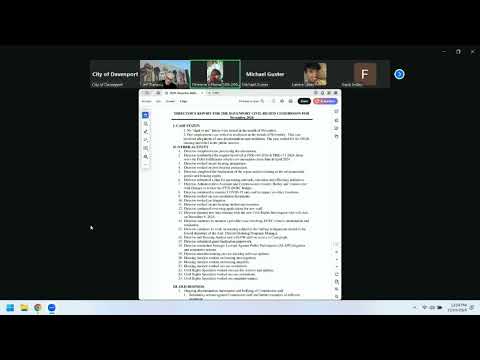
Director Lacey told commissioners the commission had no "right to sue" letters issued in November and that one employment case alleging race discrimination and retaliation settled in mediation for $6,150, with the employer also receiving anti-discrimination training as part of the resolution. Lacey said she resubmitted two FOIA requests (PRR1492024 and PRR1712024) that had been incompletely fulfilled earlier in 2024 and encountered a payment-system problem when attempting final payment; she said she would retry and circulate produced documents to commissioners once available.
Lacey outlined current case counts and staffing: 65 open employment cases (two new in the last month), 58 housing cases (three new), 18 education cases and 21 public-accommodation cases; she said the office closed one employment and one housing case last month. She also reported that one civil-rights investigator position remains open after more than six months of recruitment, while another investigator who started in October has begun training and has already produced several decisions. Commissioners and Lacey discussed reclassification or salary adjustments to make the vacant position competitive with comparable city roles.
On technology and case processing, Lacey said the housing analyst and staff gained restored and expanded access to Cartograph, the city's property-management system, which provides owner and manager contact information and service-call history; she said this will streamline intake and investigations related to rental properties. She also described updates to the commission's case-tracking software that allow integration with legal tools and an optional AI-like feature to auto-generate legal checklists and case elements; Lacey said she was awaiting a cost estimate for that enhancement.
Lacey said she submitted an Outreach Education and Efficiency Initiative Plan to HUD seeking partnership funding for the year and that HUD extended the application deadline, delaying notice of awards. Separately, she said she has researched strategic litigation against public participation and can provide a more complete report to the commission if requested.
On the cooperative agreement, Lacey explained the instrument allows the commission to accept and cross-file complaints on behalf of the Iowa Office of Civil Rights while preserving complainants' statutory rights at the state and local level; the agreement also specifies how the commission is compensated for intakes when state or federal partners (for example, HUD or the EEOC) take jurisdiction. Lacey said the agreement must be signed by the chairperson and returned by the Iowa office by the next day. Speaker 4 moved to sign the agreement and a second was recorded; the commission approved the motion by voice vote and the chair announced the ayes had it.
Votes at a glance: the commission approved the October and November meeting minutes by voice vote; it approved signing the Iowa Office of Civil Rights cooperative agreement (motion carried); and it subsequently moved into closed session to discuss litigation strategy and legal defense under code 21.51(c).
The commission entered closed session to consult with counsel on pending litigation. When public proceedings resume, the commission may take up legal defense and indemnification matters and any related votes.