Get Full Government Meeting Transcripts, Videos, & Alerts Forever!
Get email alerts on the Public Safety topic
No spam. Unsubscribe anytime.
Sheriff seeks consolidated operations complex and secure warehouse; says co‑located 911 is lower near‑term priority
Summary
Sheriff Michelle Cook urged the county to pursue an operations complex (administration, 911, detective offices, fleet, evidence and storage) and to secure climate‑controlled warehouse space because a privately provided storage site used by the sheriff may be sold; the sheriff said building 500 design work is needed immediately.
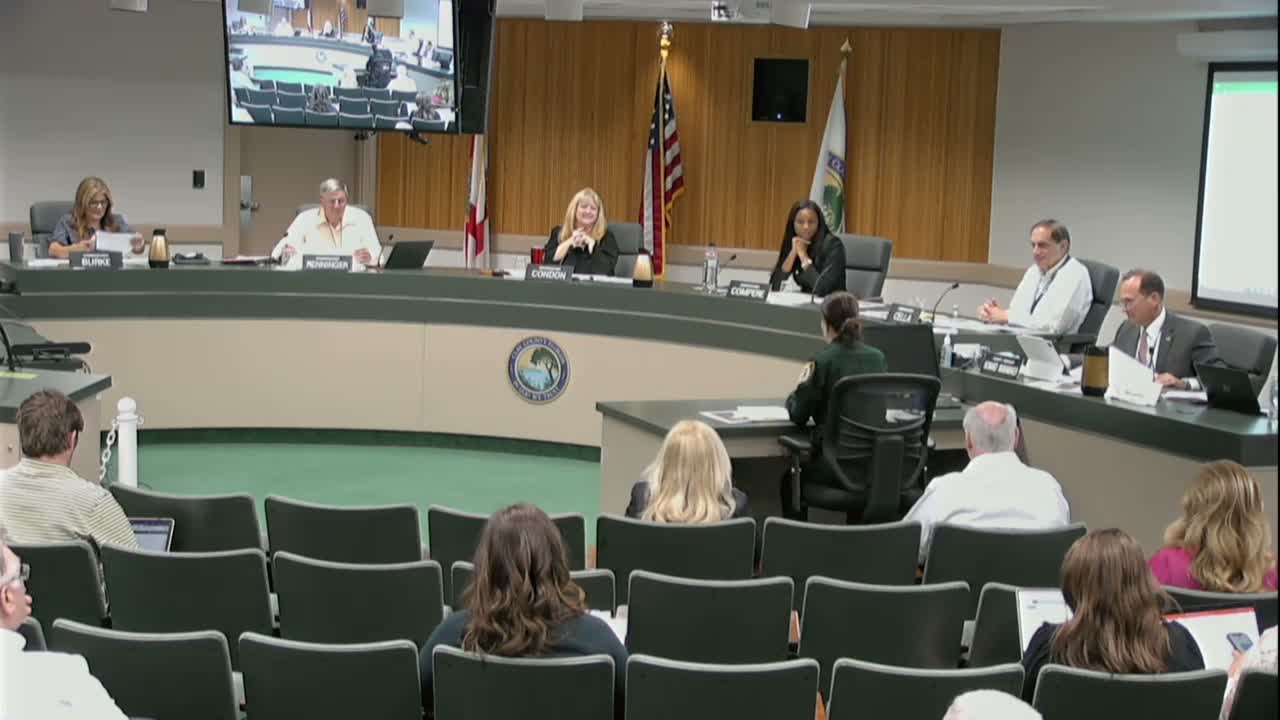
Sheriff Michelle Cook told the Board of County Commissioners the Clay County Sheriff’s Office must consolidate scattered office, storage and support functions into fewer, more efficient facilities and that staff have identified an immediate need for both office and secure storage space.
"At a minimum, need about a hundred thousand square feet," Cook said when describing a campus model that would combine administration, detectives, a consolidated communications center, fleet maintenance and storage. She told the board the sheriff's office now operates from many disparate buildings (about 96,113 square feet in total across several leased and county properties) and that consolidation could allow sale or repurpose of prime downtown properties to help pay for future needs.
Cook said a privately provided warehouse where the office currently stores expensive equipment is listed for sale, creating urgency to find climate‑controlled long‑term storage: "the person who allows us to store our items for free at his warehouse ... he's had it up for sale," she said. Emergency management director John Ward told the board the county's emergency response storage needs are currently in the order of 40,000 square feet and could grow; staff discussed phasing new warehouse construction to reach as much as 100,000 square feet with hardened, secure facilities.
On other public‑safety projects, the sheriff said she remains in favor of a co‑located 911 center but described it as a lower short‑term priority compared with immediate consolidation needs and warehouse security. The sheriff asked the board to prioritize building‑500 completion (design and tenant fit‑out) because records expansion, body‑worn camera storage and records requests make that work time‑sensitive; staff confirmed about $1.5 million was set aside for design and build‑out of Building 500 in years 1–2 of the plan.
The sheriff said a campus approach that colocates sheriff, fire and emergency management functions could capture operational efficiencies, though she emphasized discussion and partnership are needed: "we're open to that just because jails are so expensive right now and we have a lot of needs." Commissioners asked about evidence retention statutes and security standards for a warehouse; staff and facilities experts said hardened construction and secure access would be required, and that evidence retention is governed by statute.
No formal decisions were taken; staff were asked to continue planning and bring back specific options and cost estimates in a follow‑up workshop.