Get Full Government Meeting Transcripts, Videos, & Alerts Forever!
Get email alerts on the Public Safety Communications topic
No spam. Unsubscribe anytime.
Clay County approves Motorola contract to replace 800 MHz public-safety radio system
Summary
The Clay County Board of County Commissioners voted 5-0 to approve a negotiated agreement with Motorola Solutions for a new 800 MHz public-safety radio system, authorizing an advance payment for a 10-year extended service and support package and funding the purchase primarily from the countys CIP with a $12.50 surcharge covering a small general-revenue portion.
The Clay County Board of County Commissioners voted 5-0 to approve an agreement with Motorola Solutions to replace the countys aging 800 MHz public-safety radio system, including an advance payment for an extended 10-year service and support package.
County staff described the procurement as the end point of a multi-year process that began with concerns about system failures in 2010 and an RFP developed in 2014. Chief (presenter) told the board the contract as presented carried a revised figure of $11,381,000 and that the county would also pay in advance for an extended-support/warranty package that staff placed at roughly $3,618,000. "Thirteen point seven million and change is coming out of the CIP," the chief said, "and the additional 1.3, more or less, is coming out of general revenue, which will come out of the $12.50 surcharge." The initiating memo, staff said, listed a base-cost comparison of about $15 million against earlier lower bid figures.
The approved package includes equipment and services the countys public-safety teams identified as priorities: higher-tier handheld portables (the chief said the enhanced portables represent the largest single option cost, about $2,295,000) to secure AES/DES encryption and improved ruggedization, GPS for mobiles and portables (about $451,000), an ISSI interface for regional interoperability (about $148,000), and a redundant-prime configuration to avoid single-point failure (about $611,000). "If someone had died that night because we couldn't get a fire engine, a rescue unit, or a police car to their home, the family of that dead person would say $611,000 is a small price to pay," Sheriff Beasler told the board, citing a prior lightning strike and near-loss of operations.
Commissioner Robinson urged greater procurement rigor before approving the warranty payment. "We've gone outside our purchasing policy twice now," Robinson said, adding that the 10-year warranty (about $3.6 million) merited a separate competitive bid so the county could compare "apples to apples." County staff responded that the warranty was an option in the original bid packages and that staff had comparative data available if commissioners wanted to revisit it.
Implementation and operations were also discussed: staff said reprogramming subscriber units would largely be done by county technicians in batches, not by bringing every unit in at once, and that the county chose not to include over-the-air programming because many subscriber units lack the required Wi-Fi capability. Staff estimated full system installation in about a year, with some components possibly in place sooner.
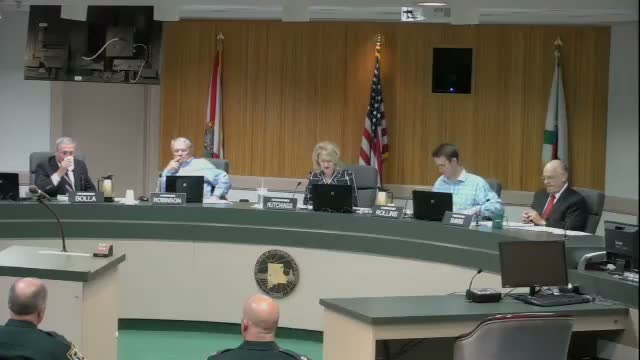
The motion to approve the agreement, including authorization of advance payment for extended service and support, was moved by Commissioner Rollins and seconded by Commissioner Davis; the board carried the motion 5-0.
The agreement includes multiple exhibits and a system-level warranty and liquidated-damages language negotiated by the county; several commissioners and staff said those contract terms were important to protect schedule and performance. The board adjourned following the vote.