Get Full Government Meeting Transcripts, Videos, & Alerts Forever!
Get email alerts on the Land Use Denial topic
No spam. Unsubscribe anytime.
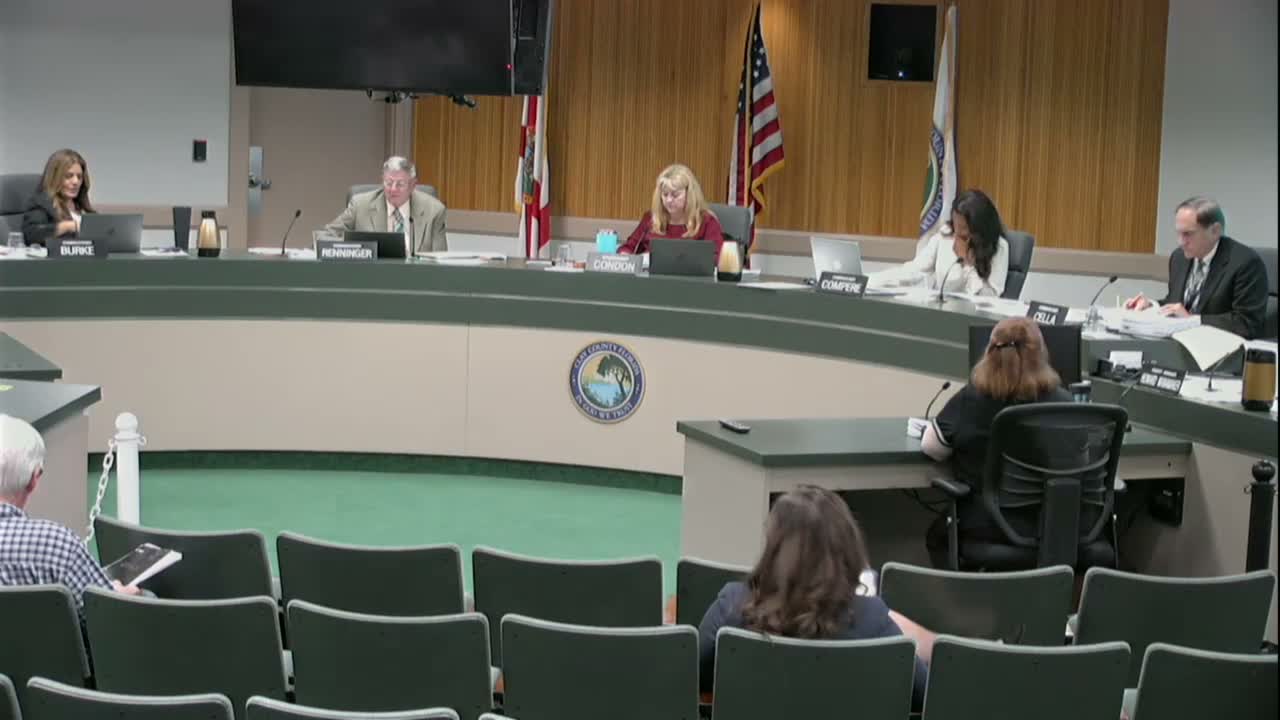
Commission denies Blanding/Tanglewood future‑land‑use change after neighbors warn of flooding and school strain
Summary
The board voted 4–1 to deny a proposed large‑scale future‑land‑use change for about 55.8 acres near Blanding Boulevard that would have allowed denser multifamily development; neighbors and school officials warned the site floods, drains poorly and that nearby schools are already at capacity.
The Clay County Board of County Commissioners on Tuesday denied a transmittal for a large‑scale future‑land‑use change near Blanding Boulevard that would have increased allowable residential density on roughly 56 acres.
The applicant proposed moving a frontage band of commercial land and converting the interior from UC‑10 to UC‑16 to permit market‑rate multifamily housing; the conceptual plan showed approximately 92 units and five apartment buildings. Neighbors and multiple residents urged denial, citing chronic flooding in the Tanglewood/Independence area and concerns that area schools are already near capacity.
"Development on this property right now would be a disaster because of the flooding alone," said Jamie Clay, a Tanglewood resident who provided the board with the site’s earlier water‑management permit history and pointed to overgrown county retention ponds and constrained culverts under Blanding Boulevard.
Applicant representatives said the project would use an existing St. Johns River Water Management District permit and that any development would retain runoff on site and build finished floors above FEMA flood elevations. A project planner noted that under current law structures would be required to meet FEMA elevation standards and SJRWMD retention rates.
After extended public comment and back‑and‑forth between staff, the applicant and residents, the board voted 4–1 to deny the transmittal. Commissioners cited neighborhood flooding history, infrastructure concerns and school capacity as reasons to decline forwarding the amendment for state review.
The denial does not preclude the applicant from returning with a different proposal; commissioners said they would be receptive to development concepts that better match current infrastructure capacity and avoid increased wetland impacts.