Get Full Government Meeting Transcripts, Videos, & Alerts Forever!
Get email alerts on the Cares Act topic
No spam. Unsubscribe anytime.
Clay County commissioners pause building purchases as state tightens CARES Act rules, debate priorities for $20 million plan
Summary
County staff told the Clay County Board of County Commissioners that updated Treasury/state guidance bars buying or building new properties with CARES Act funds and recommended pausing property purchases; the board continued the public hearings to Oct. 13 and debated reallocating funds to reimbursements, nonprofits and individual relief.
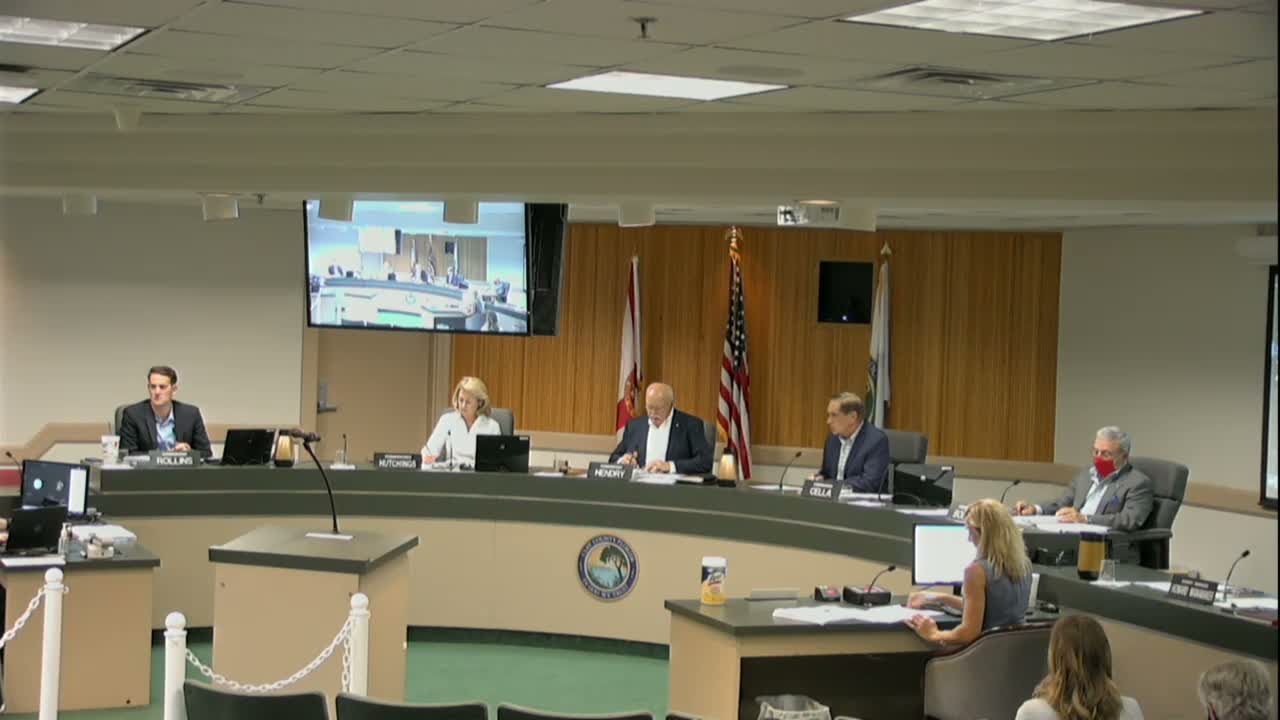
Clay County commissioners on Sept. 8 paused plans to buy two buildings proposed for public-health and warehouse use after staff reported new state and federal guidance limiting CARES Act spending. Troy, the county's CARES Act lead, told the board: "Their guidance currently is no purchasing of buildings, no construction of buildings." The board voted to continue the public hearings on both purchases to the Oct. 13 meeting while staff seeks clearer state guidance and a consultant to manage reimbursements.
The update reshaped a broader $20 million CARES Act spending plan. Troy and other staff said the county has accounted for prior CARES allocations, has executed agreements for additional tranches and estimates roughly $17.6 million in reimbursable public-safety costs the county may claim under the new interpretation. Troy described the change as a shift from direct purchases to seeking reimbursement for eligible public-safety expenses and then using that reimbursed money for county priorities.
Public-health officials urged urgency. Heather, the county's public-health director, described current clinic conditions as untenable: "I have 23 COVID staff working in 2,500 square feet," she said, adding that waiting-room capacity and building problems such as mold and leaking roofs impede testing and vaccination efforts. Commissioners acknowledged the facility problems but disagreed on the right use of CARES funds; some favored redirecting more of the CARES plan to immediate individual and nonprofit assistance while reserving reimbursed amounts for longer-term capital needs like a health facility.
Staff and the county attorney warned that shifting guidance creates legal and audit risk. The county attorney said federal oversight offices and state interpretations may require repayment if a purchase later proves ineligible. Commissioners asked about legal recourse and whether a lawsuit would be feasible against state or federal entities, and staff said the state is the prime recipient and would be the likely point of contact for disputes.
On program specifics, Troy said about 41 percent of business applications for direct assistance had been approved and 33.7 percent needed more information; staff said they expect application work to continue for several weeks. The board discussed using CARES-authorized reimbursements to reconstitute the general fund, increase individual/business assistance, and fund nonprofits. Options such as extending temporary Internet service to households were described as feasible but limited (staff estimated roughly $30 per device per month, about $30,000 for 1,000 hot spots for three months).
Next steps: the board continued the public hearings and CARES Act property decisions to the Oct. 13 meeting so staff can report back with the state's consultant on the reimbursement process, clarified guidance on refurbishment versus new construction, and recommendations on reallocating the proposed $20 million budget. Staff committed to provide a set of options and associated compliance checks at that meeting.
Outcome: No purchases were authorized tonight; the board continued Items 1 and 2 to Oct. 13 for more state guidance and consultant input.