Get Full Government Meeting Transcripts, Videos, & Alerts Forever!
Get email alerts on the Medicaid Funding topic
No spam. Unsubscribe anytime.
Lawmakers briefed on size of DPHHS budget, FMAP trends and pressure on tobacco funds
Summary
Legislators viewed an LFD interactive tool showing the Department of Public Health and Human Services is the state’s largest spending agency and discussed Medicaid totals, a roughly $62.4% FMAP for 2025, and the fiscal risk from falling tobacco revenue and possible federal match changes.
HELENA — Lawmakers on a joint policy-and-budget committee were shown a new Legislative Fiscal Division (LFD) interactive tool and were warned Friday that shifts in federal matching rates and falling tobacco revenues could leave Montana scrambling for tens or hundreds of millions of dollars to sustain Medicaid and other public-health services.
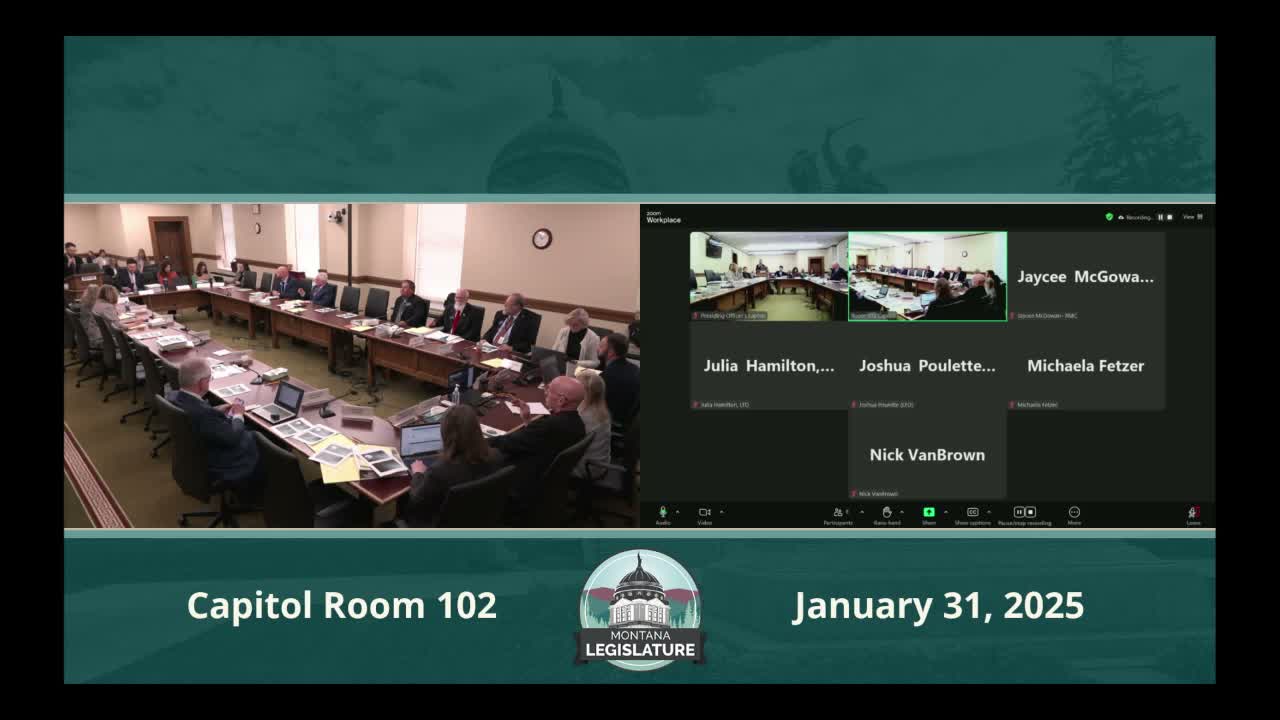
Nick Van Brown of the Legislative Fiscal Division demonstrated the web-based “state of Montana expenditures” tool, showing fiscal 2024 spending by section, fund type and agency. "This is the expenditures for fiscal 2024," Van Brown told members as he navigated charts that break out general fund, state special and federal dollars and allow members to toggle between ongoing and one-time spending.
The presentation framed the Department of Public Health and Human Services (DPHHS) as the largest chunk of the state budget. LFD analysts then summarized the governor’s Medicaid request: roughly $3.1 billion for traditional Medicaid and about $2.0 billion for Medicaid expansion, or about $5.1 billion combined — largely financed by federal matching dollars, the analysts said.
The committee also heard a technical briefing on FMAP, the Federal Medical Assistance Percentage that determines the federal share of traditional Medicaid. An LFD analyst explained Montana’s projected FMAP for 2025 is about 62.4%, meaning the federal government would pick up roughly $62 of every $100 spent on traditional Medicaid. The analyst added that a one‑percentage‑point change in FMAP would translate to approximately $16–17 million in additional state funds in a single year, and that multi‑year changes can compound into materially larger biennial budget impacts.
Senator Glenn cautioned members that a federal policy change to shift Medicaid expansion’s 90% federal match toward each state’s traditional FMAP would quickly increase the state’s obligation. "If the feds would change the FMAP on Medicaid expansion... we would be looking at $280,000,000 a year extra state funds," he said, and estimated a biennial shortfall on that order of magnitude (the transcript includes inconsistent large-number wording; the committee’s working estimate cited during the briefing was about $560 million over the biennium).
Analysts also described state special revenue dynamics: revenues tied to cigarette taxes and some tobacco-related funds (identified in the presentation as the Tobacco Health and Medicaid Initiatives Fund, fund 02772) are declining as cigarette sales fall, while the insurance premium tax fund (fund 02597) has been growing. LFD said the executive budget request reduces reliance on shrinking tobacco-derived funds and leans more on other, more stable or growing revenue streams.
Committee members pressed staff for clarity about which parts of DPHHS spending are Medicaid‑driven and how enrollment trends have changed since expansion and the COVID-era coverage pause. LFD noted that enrollment spikes from 2020–2023 were affected by federal requirements that paused disenrollments during the public health emergency and that subsequent redeterminations produced a substantial drop back toward pre‑pandemic trends.
The presentation materials and slides were offered for distribution to the committee for further review. Presenters and members emphasized this was informational and preparatory: no formal action or vote occurred during the briefing. Members closed by urging attention to fiscal notes on bills and continued coordination between policy and budget work.
The committee is expected to rely on the LFD tool and the distributed materials as members evaluate fiscal notes and potential revenue strategies in the coming weeks.