Get Full Government Meeting Transcripts, Videos, & Alerts Forever!
Get email alerts on the Wildlife Management topic
No spam. Unsubscribe anytime.
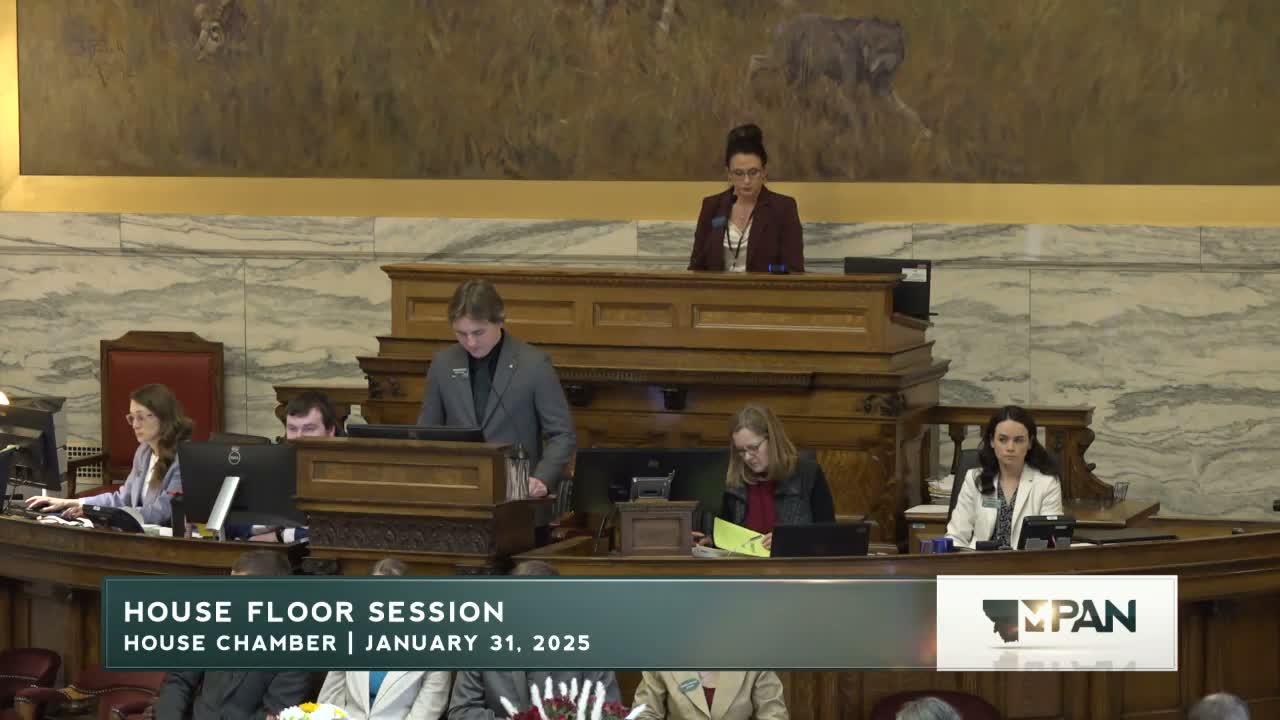
Montana House advances wolf-management bill after heated floor debate and amendment
Summary
House Bill 176, proposing broad changes to wolf-hunting rules and hunting tools, passed second reading 57–42 after extended floor debate, a successful amendment and sustained exchanges over science, regional management and economic impacts.
House Bill 176, a measure that would inactivate certain wolf-hunting restrictions and allow expanded hunting methods and quotas when population thresholds are met, passed second reading in the Montana House of Representatives by a recorded vote of 57–42.
The bill, introduced on the floor as "House Bill 176" by Representative Manus, drew extensive debate about how best to manage wolf populations in Montana and whether statewide rules should override region-by-region management. Representative Maness, who moved the motion to recommend HB176 do pass, framed the measure as a way to give the Department of Fish, Wildlife & Parks (FWP) ‘‘the tools and the directive to make that happen.’’
Why it matters: supporters said the bill equips FWP to reduce wolf numbers in areas experiencing livestock or ungulate impacts; opponents said the proposal would prioritize numerical reduction over ecological science and create unintended consequences for packs and the broader ecosystem.
Floor action: Representative Albus offered an amendment (HB0176.002.001) that the House adopted by voice and recorded tally (78 ayes, 21 no). After more than an hour of argument from members across the chamber, including sustained exchanges on scientific counting, hunting practices and economic impacts, the House voted to recommend HB176 do pass on second reading (57 ayes, 42 no).
Key exchanges and themes: Representative Maness emphasized the bill’s alignment with U.S. Fish and Wildlife guidance and cited state materials that, he said, justify measures to reduce wolf numbers in some regions. Representative Eisley and others stressed that long-term FWP management has produced stable wolf numbers and warned that broad statewide quotas risk undermining region-specific science. Representative Powers argued a statewide rule would improperly treat every region the same and risk damaging tourism-dependent economies in areas where wolves are not a livestock concern; he asked members to ‘‘vote no’’ on the measure. Representative Running Wolf framed the measure as a partisan ‘‘hunt baby hunt’’ approach, urging members to ‘‘kill this bill’’ and calling for integrating traditional and indigenous practices into wildlife management.
Sponsor response and next steps: The sponsor urged a green vote, saying the bill provides needed management tools and noted ranchers’ costs from depredation and mitigation measures. Because HB176 passed second reading, it will move through committee report processes toward third reading on the House floor.
Vote specifics: Amendment HB0176.002.001 passed (78–21). Second-reading passage recommendation for HB176 recorded 57 ayes and 42 no.
Speakers quoted in this story are those recorded on the House floor during debate.