Get Full Government Meeting Transcripts, Videos, & Alerts Forever!
Get email alerts on the Lead Abatement topic
No spam. Unsubscribe anytime.
Butler County hears progress report on Lead Safe Ohio work and funding
Summary
SELF updated the Butler County Commissioners on lead-abatement work funded through House Bill 45, reporting nine homes abated to date, roughly $634,000 spent so far, and new state-released dust thresholds that will require contractors to meet stricter clearance testing.
SELF housing staff updated the Butler County Commissioners Dec. 16 on local work funded through the state—s Lead Safe Ohio program, describing completed abatements, current spending and operational challenges as regulators lower dust-limit standards.
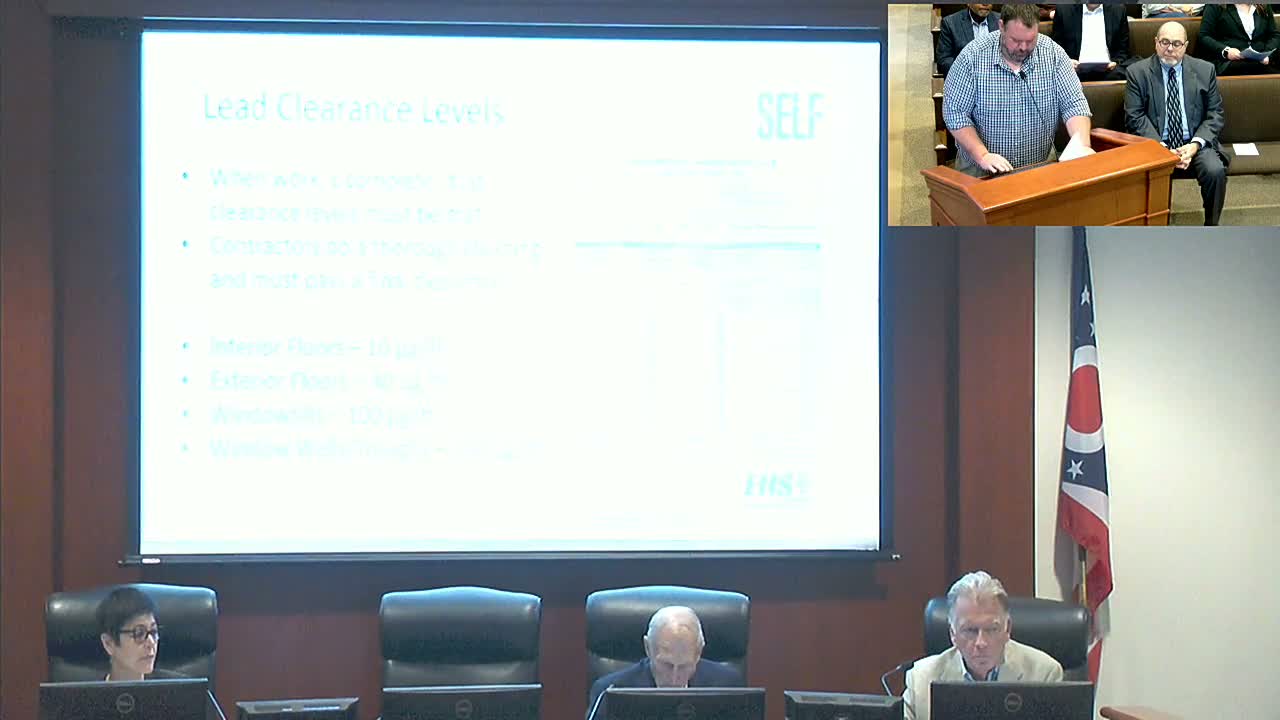
Jeff (SELF—s executive director) introduced the program and turned the presentation over to Bob Didion, SELF—s housing program coordinator, who explained health risks from lead exposure and the program—s focus on windows and doors. Didion said the program requires higher-than-typical RRP (renovation, repair and painting) work in the grant—s scope and that contractors must meet clearance testing before a job is complete: "Right now, interior floors have to meet 10 micrograms per square foot" and "the EPA is lowering them now."
Didion traced the grant to House Bill 45 and said the statewide investment was about $100 million; Butler County—s initial allocation was reported as about $2,075,000 and SELF later secured approximately an additional $180,000. He said SELF has completed nine homes so far, with two others expected to finish within days, and that year-to-date grant spending is around $634,000 with a projection of more than $700,000 by the end of December. "Outcomes so far year to date, we have 9 homes completed currently," Didion said.
Commissioners asked how SELF prioritizes applicants and whether owner-occupants or private investors receive different treatment. Didion said units funded by the grant follow the program—s income eligibility (he cited the 80% AMI threshold used by the grant) and that SELF had contracts requiring a six-unit property owner to reserve units for low-income families for three years, but he acknowledged SELF did not have a dedicated, detailed monitoring plan to present at the hearing: "We have a signed contract with him that our attorney drew up," he said, and "we can drop in at any time and ask him for that information," while conceding he did not have a full monitoring answer on hand.
Commissioner Rogers and other board members raised concerns about the program—s per-unit cost when owners also contribute significant funds; Commissioners urged staff to return with options to stretch county grant dollars and to consider sliding scales or longer affordability commitments when owners invest heavily. The Board asked SELF to provide formulas or a model showing how to leverage county funds to assist more households.
SELF also described partnerships intended to expand referrals and sustain work beyond the current grant period, including an agreement to receive referrals from Cincinnati Children—s Hospital lead clinic and plans to pursue CDBG and other funding.
Next steps: Commissioners asked SELF to return with more detailed proposals on prioritization, enforcement mechanisms for affordability commitments and financial leverage scenarios before the grant period ends in early 2026.