Get Full Government Meeting Transcripts, Videos, & Alerts Forever!
Get email alerts on the Transitional Housing topic
No spam. Unsubscribe anytime.
Champaign council approves special use permit for CU at Home transitional housing at 1207 South Madison
Summary
Council approved a special use permit 8–0 for a transitional housing facility proposed by CU at Home at 1207 South Madison, after extensive public comment for and against and staff clarifications about quasi‑judicial limits and operational conditions including a police‑call review trigger of 10 calls per calendar year.
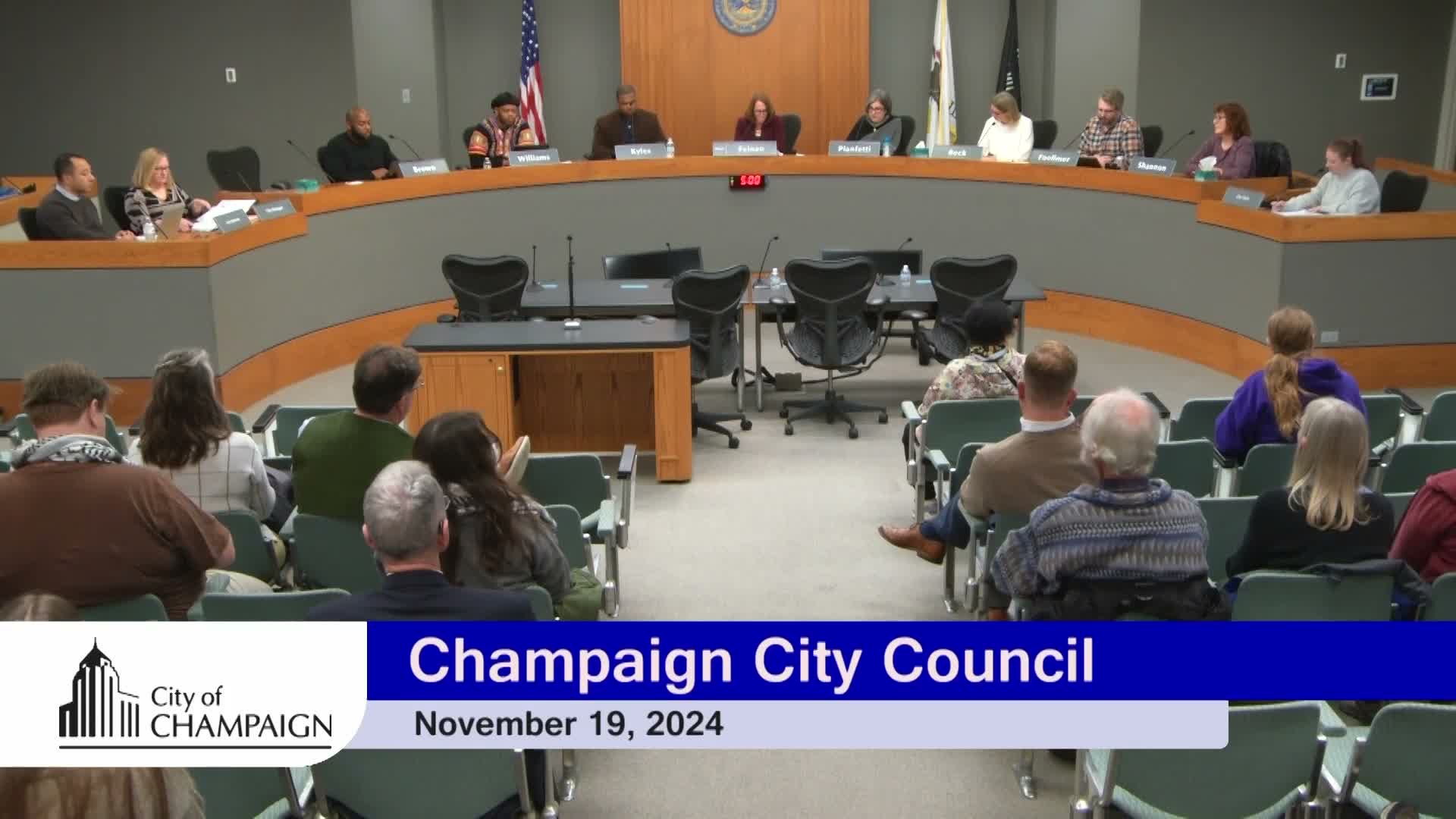
Mayor Deborah Frank Feynan and the Champaign City Council on Nov. 19 approved a special use permit for transitional housing at 1207 South Madison Avenue, a facility to be operated by CU at Home. The council voted 8–0 to adopt Council Bill 2024‑186 after public hearing and staff explanation of legal constraints tied to Plan Commission testimony.
The project was described by the applicant and plan staff as a ‘mid‑barrier shelter’ that falls under the zoning ordinance’s definition of transitional housing — a dormitory‑style, time‑limited residence with regular training or counseling and a maximum stay of two consecutive years. Planning staff noted the Planning Commission recommended approval with six conditions and reminded the council that, under recent Illinois Supreme Court guidance, the council’s decision must be based on evidence presented to the Plan Commission.
Supporters and neighbors testified at length. Melissa Courtwright, executive director of CU at Home, urged the council to approve the permit and meet the needs of people who are unhoused: “I am standing with this community, asking you to approve the special use permit tonight and help our neighbors,” she said. Steven McGuire, who said he does business in Champaign, argued that safe shelter and services reduce desperation and crime: “When people have a bed to sleep in, a place where they can go to the bathroom, a place where they can wash their clothes, are a lot less desperate and therefore a lot less dangerous,” he said.
Opponents voiced safety and property‑value concerns. A nearby business owner said the location — adjacent to schools, a park and day‑care facilities — was not appropriate for the proposal, citing fear that the shelter would attract loitering and reduce neighborhood safety and property values.
CU at Home and program staff described intake and supervision procedures intended to address those fears. Cedar Edward King, CU at Home’s men’s program director, said the organization uses a vulnerability and motivation matrix during intake and holds residents to high behavioral standards; he said that CU at Home screens out people with a recent violent history and would not provide residential accommodation for registered sex offenders at the site.
City staff and several council members discussed the Plan Commission’s recommended conditions and how to enforce operational commitments. Planning staff explained the review mechanism tied to police responses: if the site records more than 10 police calls in a calendar year, staff may initiate a review that could lead to additional conditions or referral back to the Planning Commission and council for reconsideration. The planning office said administrative adjustments could address minor incidents, while significant problems would go through the full review process.
The council’s discussion recognized the limits of zoning review for operational practices. Several members said they wanted stronger, enforceable conditions — including earlier review cycles — but also noted that, because the special use permit is quasi‑judicial, operational details outside the Plan Commission record are difficult to add as zoning conditions without referral back to the Planning Commission. The council ultimately approved the permit 8–0.
Next steps: the special use permit takes effect consistent with city procedures and existing zoning processes; any request to alter or revoke conditions would follow the Planning Commission and council review described by staff.