Get Full Government Meeting Transcripts, Videos, & Alerts Forever!
Get email alerts on the HB 1016 — Adjutant General Budget topic
No spam. Unsubscribe anytime.
House committee vets Adjutant General budget, debates $6 million state match and emergency clauses
Summary
The House Appropriations Government Operations Division reviewed House Bill 1016, focusing on FTE counts, a proposed $6 million state match to leverage federal sustainment funds, underinsured facilities, and emergency clauses the committee added to multiple budget lines.
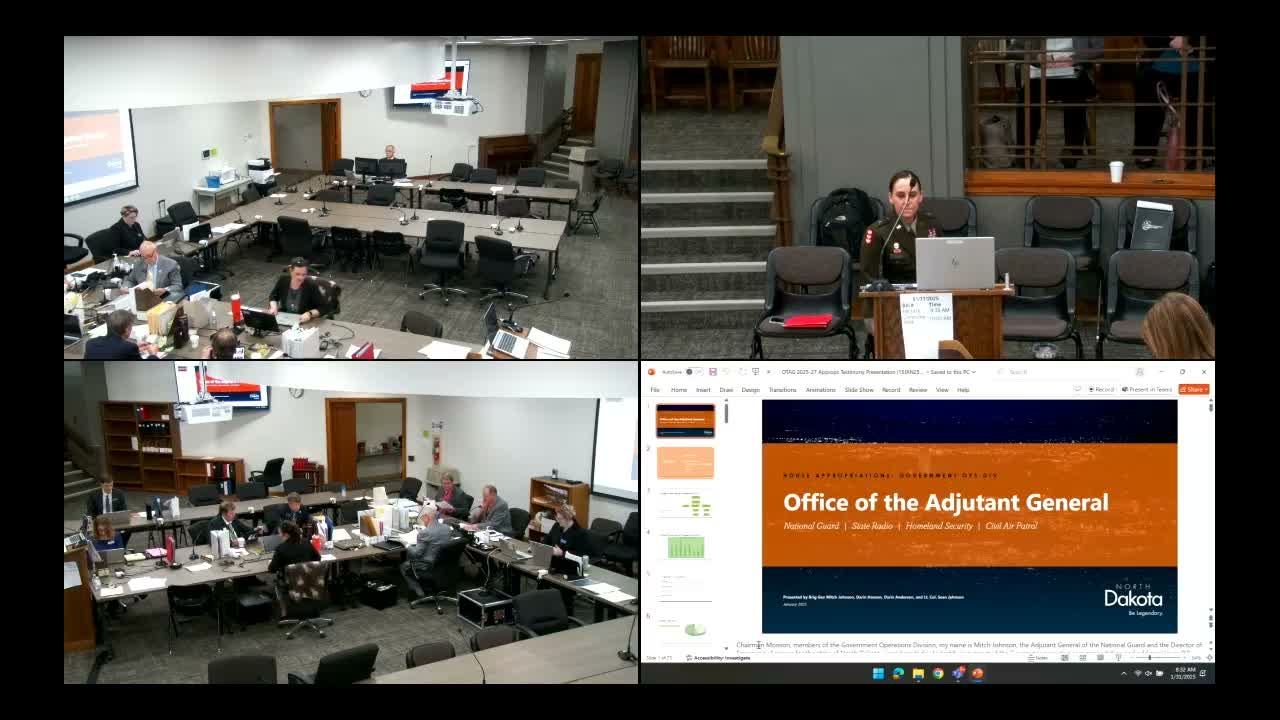
BISMARCK — The House Appropriations Department’s Government Operations Division moved through testimony on the Adjutant General’s budget under House Bill 1016 on the committee’s agenda, singling out a request for state matching funds and several staffing questions.
Jackie Huber, deputy adjutant general for the North Dakota National Guard, told the committee the Guard is seeking authority to manage its facilities and projects across 330 buildings on 12 complexes and is asking for a state match split that would total roughly $6 million: $1.5 million in the base budget and $4.5 million in one-time or special funding. "In the last 3 years, we've received approximately $28,000,000 in federal reimbursement for 83 different projects," Huber said, noting the Guard relies on predictable state matches to plan projects that must align with federal fiscal-year awards.
Why it matters: federal sustainment funds generally arrive on Oct. 1 and require an available state match for a project to proceed. Committee members debated whether the state contribution should be an ongoing base appropriation — which the Guard said provides predictability — or one-time funding from SIF, which members said is sometimes easier to approve amid competing biennial priorities.
Committee members also pressed for clarity on personnel lines. Staff reported the Adjutant General has about 233 FTEs across three divisions and is seeking seven new FTEs; only 24 of the positions are 100% general fund, and roughly 71% of positions include some federal match. The committee asked staff to produce a clear spreadsheet distinguishing general, federal and other funds for each FTE line so members can explain the budget on the House floor.
The Guard also described recent findings that some buildings are underinsured following a fire at Camp Grafton Training Center. Huber cited one example: the Raymond J. Bond armory in Bismarck is insured for about $17 million but replacement costs are closer to $52 million, and federal cooperative agreements require consistent insurance across federally funded facilities.
Other requests discussed included a $34 million authority for a Regional Training Institute billeting addition (100% federal authority) and design authority for a Williston readiness center; presenters said the city donated land valued at over $6 million and the Guard is requesting design funds now with build funding in a future session.
Committee action: Members verbally agreed to add emergency clauses to several lines so funds can be acted on immediately if needed. The committee placed emergency clauses on the Guard’s critical-infrastructure state-match request, the Civil Air Patrol siren acquisition line, the Next Generation Leadership program coordinator, and Storm Act funds so the state can act on federal awards already received.
What’s next: staff committed to providing a detailed FTE and funding breakdown and to return with further options on whether the Next Generation program’s two proposed FTEs could be consolidated. The committee did not record a roll-call vote on the emergency clauses during the hearing; members signaled unanimous or general assent on the record and staff will reflect the emergency clauses in bill language going forward.