Get Full Government Meeting Transcripts, Videos, & Alerts Forever!
Get email alerts on the Literacy K 2 topic
No spam. Unsubscribe anytime.
Kennett K‑2 literacy effort shows early gains at Mary Dean; district plans library summer reading partnership
Summary
District literacy leaders told the curriculum committee that kindergarten interventions, coaching and a Step by Step partnership have raised several literacy measures (phonological awareness and phonics up to about 70%); the district proposed a four‑week summer reading challenge with the Kennett Library to expand reach.
Kennett Consolidated School District literacy leaders reported measurable early gains and a multi‑year plan to scale structured literacy practices across elementary grades during the Jan. 29 Curriculum Committee meeting.
Dr. Collins said Pennsylvania’s recent Chapter 49 guidance prompted the district’s literacy stakeholder work and a partnership with Step by Step to provide online learning and coaching for teachers. “Pennsylvania amended Chapter 49 to require school districts to align with the structured literacy...,” Dr. Collins said, describing the training and the district’s literacy needs assessment from 2023 that underpins current work.
At Mary Dean kindergarten center, staff described implementing a daily literacy block, external coaching visits, small‑group instruction and targeted interventions. Principal Reynolds and the Mary Dean team reported assessment snapshots showing about 70% of kindergarten students at or above grade level on phonological awareness and phonics (up from 64% and 54% respectively last year), listening comprehension at about 63% and picture vocabulary at 67%.
“Seventy percent of our students are currently meeting the grade‑level expectations,” Principal Reynolds said, crediting professional development and in‑class coaching for the gains.
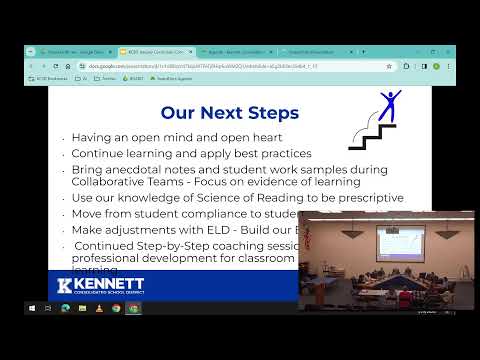
Presenters described specific curriculum tools (Benchmark Advance, Benchmark Phonics, Heggarty, and formative one‑minute screenings used to group students for targeted support) and said the district will continue Step by Step coaching sessions and in‑person professional development across K–2, then expand training into upper elementary grades.
Staff and board members also discussed staffing constraints: the district said it has struggled to recruit qualified instructional assistants (which commonly require an associate degree) and noted it had recently hired an English‑language‑development paraeducator and an RBT to provide additional classroom support.
Separately, Dr. Connolly outlined a proposed four‑week summer reading challenge to run with the Kennett Library: the partnership would use an app to log challenges, provide books for students to keep, and host two family events at the library tied to literacy themes; the library has offered space and some program funding.
District staff said they will monitor multiple data sources and return with longer‑term trend data after another year of instruction and screening. The committee scheduled future agenda items on special education, AI and integrated science, and said staff will report back on literacy progress.