Get Full Government Meeting Transcripts, Videos, & Alerts Forever!
Get email alerts on the School Finance topic
No spam. Unsubscribe anytime.
Scranton SD financial update: state subsidy timing, charter placements and construction services strain budget lines
Summary
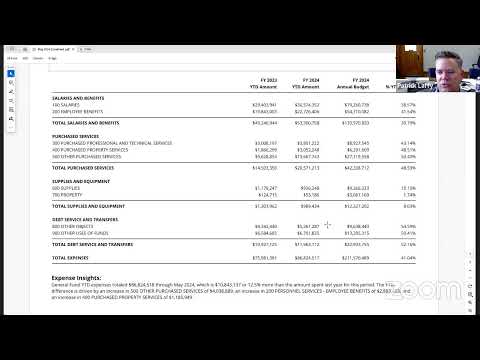
Pat, the district business manager, reported year‑to‑date finances through May 2024, explaining a ~$24M state subsidy timing boost (roughly $20M timing effect), flagged $800K construction service overrun and higher outside charter/cyber tuition (budgeted ~875 vs ~944 actual placements).
Pat, the district business manager, presented the Scranton School District's year‑to‑date budget performance through May 2024 and walked the board through revenue and expense drivers.
On revenues Pat said local taxes are the largest source and that state revenue showed a roughly $24 million increase compared with prior years; he explained most of that—about $20 million—was a timing effect tied to a subsidy payment arriving days earlier than in prior years. Pat cautioned the spike is explainable by calendar timing rather than an underlying recurring increase.
Pat reported local real‑estate taxes slightly ahead of the prior period (around $50,000) and earned‑income tax collections about $600,000 ahead on a $14,000,000 budget. He said conversion to the payroll‑preparation tax contributed roughly $3.2 million to other local revenue, and noted delinquent real‑estate collections left roughly $900,000 still to be recovered.
Federal revenues, Pat said, total about $7,000,000 with Title programs comprising the largest portion (over $4,000,000); the decline from prior federal levels is driven mainly by the sunsetting of ESSER II and the transition to ARP/ESSER III spending.
Turning to expenses, Pat said salary and benefits are pacing as expected (about 40% of the year) but purchase services are running high, driven in part by construction services (object 450) roughly $800,000 ahead of budget. He clarified many of those construction costs are funded from the general fund (fund 10) rather than the capital fund (fund 32) and said quarterly ESSER cash reports should help align federal reimbursements with expenses.
Pat also flagged student‑transportation costs related to specialized runs and vehicle needs, and said outside tuition for charter and cyber placements exceeded budget assumptions — the district budgeted about 875 outside placements and ended the year nearer 944 — which contributed to higher expenditures. He added that in‑house cyber enrollment and ongoing efforts to bring students back into the district program are part of the containment strategy.
Pat closed by noting encumbrances for large technology purchases (Chromebooks, Promethean boards and carts) will cause supply spending to rise in the next report; he also said the district had refunded variable‑rate bonds to a 10‑year fixed structure for greater budget consistency. The board did not take formal action during this update; Pat said central administration will continue monitoring purchase services as the preliminary 2025 budget is prepared.