Get Full Government Meeting Transcripts, Videos, & Alerts Forever!
Get email alerts on the State Budget Negotiation topic
No spam. Unsubscribe anytime.
House and Senate negotiators press budget talks as disagreements remain over $350M LCF, PREP 2.0 and supplements
Summary
House and Senate negotiators continued marathon budget talks, trading proposals over a proposed $350 million Local Capital Fund (LCF) deposit, the composition of PREP 2.0 and added water funding, and several supplemental requests — including a $10 million commerce marketing ask and a workforce commission letter seeking $5 million.
Negotiators from the state House and Senate met to continue line-by-line budget negotiations, but significant differences remained over major capital and supplemental funding proposals.
Speaker 5, presenting the Senate position, said the Senate is carrying a $350 million deposit for the Local Capital Fund (LCF) and listed projects expected to be funded through that deposit, including a DEQ parking garage, a new OSBI headquarters, OETA transmitter upgrades and the RSU science building. "It is a Senate bill 1433, that was sent over," Speaker 5 said when introducing the LCF item and the related project list.
Speaker 2 and Speaker 1 pushed back. Speaker 2 noted the state Board of Equalization (BOE) certified a $299 million baseline and said the House does not agree with the additional $350 million deposit; Speaker 1 said the House would prefer to use cash for smaller projects and proposed a $20 million threshold under which items would be paid from one-time cash rather than LCF financing. "We would like to propose that anything that we agree to that is funded... anything $20,000,000 or under is just cash," Speaker 1 said.
On PREP 2.0, Speaker 5 showed a $250 million fund level; Speaker 2 said the House wants clearer project lists before agreeing to a number and said the House would like to include a $125 million water component linked to PREP. Both sides agreed that projects drawn from the PREP fund would be authorized by separate, individual bills, and Speaker 2 urged negotiators to define the specific PREP projects before agreeing to totals.
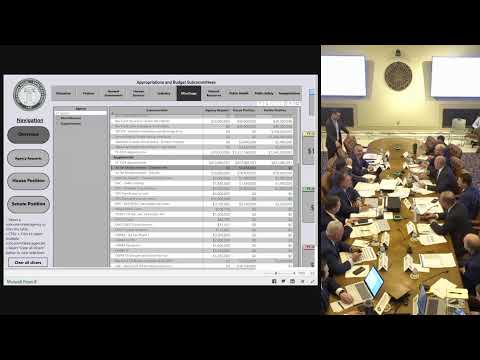
The groups also debated the closing fund balance and how figures should be presented on the public portal. Different documents produced balances ranging from roughly $2.9 million available for new projects to a $37 million cash balance when encumbrances were included. "Showing the $1,000,000,000 as an expenditure... is entirely misleading," Speaker 1 said in a broader accounting dispute about how a $1 billion savings set-aside is displayed on the portal.
Several supplemental requests and separate funding items were discussed. Speaker 5 described a $10,000,000 supplemental marketing request routed through Commerce to recruit businesses and talent; Speaker 2 said that request had not been part of prior subcommittee deliberations and asked whether the lieutenant governor or Commerce had formally communicated it. "If the $10,000,000 is your request and it's request from lieutenant governor of the state of Oklahoma, we'll... come to your $10,000,000 number to market Oklahoma," Speaker 1 said when asked to accept the figure.
A recent letter from the workforce commission seeking $5,000,000 to fund staffing and analysis for workforce development also drew attention; several members said they had not received the letter and asked for time to review it before taking a position.
Negotiators touched on other proposals: Speaker 5 flagged House Bill 4063 and a $20,000,000 law-enforcement transfer-pay proposal that Speaker 2 said was underfunded relative to the bill's intention and raised concerns about municipal-sheriff pay differentials; participants said they would pursue a better-defined grant structure rather than an immediate one-year payout. On maternal-health spending, members discussed converting a proposed $5,000,000 pregnancy tax credit into a recurring $18,000,000 appropriation for the Choosing Childbirth program in the Department of Health.
Throughout the meeting negotiators emphasized the need for transparency and agreed to continue working through the portal and follow-up conversations. Members also discussed moving to a quieter committee room for better audio and public access and tentatively agreed to reconvene in the afternoon to continue negotiations.
Next procedural steps: negotiators tabled some items for further review, requested missing letters and documentation be circulated to both sides, and set a tentative reconvene time of 2:30–3:00 p.m. to resume line-by-line negotiations.