Get Full Government Meeting Transcripts, Videos, & Alerts Forever!
Get email alerts on the LCF And Closing Fund topic
No spam. Unsubscribe anytime.
Leaders inch toward deal on LCF projects and $20M closing‑fund request; negotiators trade unclaimed‑property sweeps and project funding
Summary
House and Senate negotiators reviewed a list of LCF and capital projects (including university wet labs, OSBI HQ, DPS phase 2) and discussed funding tradeoffs — including sweeping unclaimed property and a $20M allocation to the governor’s Quick Action Closing Fund and $2.85M for transmitters — while asking staff to reconcile spreadsheets before final agreement.
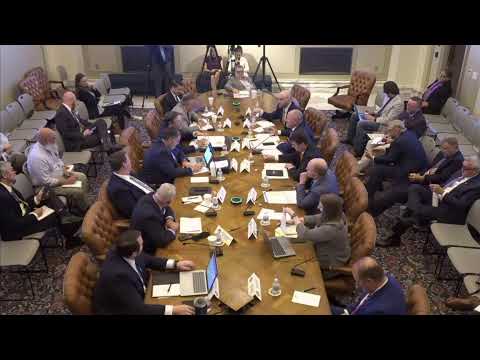
Lawmakers in the leadership meeting reviewed specific projects and revenue trades as they worked toward a budget agreement. Negotiators listed multiple large capital projects they expect to treat as LCF items (examples named in discussion included university wet labs, OSBI new headquarters, DPS phase two, and OSU/Tulsa hospital work) and signaled broad agreement on many line items while continuing to negotiate totals and revenue sources.
The Senate proposed funding the governor’s $20,000,000 Quick Action Closing Fund by increasing the sweep of unclaimed property and leaving a healthy residual balance. The House countered with a mixed approach: $10,000,000 drawn from unclaimed property plus $10,000,000 in cash to reach the $20,000,000 ask. Negotiators discussed an array of single‑pay projects under $20M (parking garage, transmitter work, regional projects) and whether operational costs should be coded as recurring operations or capital investments.
A specific compromise discussed in the meeting was funding broadcast transmitters used for public safety at $2,850,000 (with up to $3,000,000 as requested), with $150,000 for operations, paired with removing a $2,000,000 water‑quality request from the table as part of the package if deposit and LCF numbers were adjusted. Leaders said staff would reconcile House and Senate spreadsheets and verify parity across numbers before reconvening. No binding appropriation language or final enactment appeared in the transcript.
Proper names and agencies mentioned repeatedly included OMES, Commerce, OSU, OU, OSBI, DPS, DEQ, Rogers State and OETA. Several negotiators asked Commerce to include encumbrance dates on project lists so leaders could see how long funds had been reserved for projects.
Next steps: staff reconciliation of spending spreadsheets, further huddles, and a planned reconvening to finalize unresolved items.