Get Full Government Meeting Transcripts, Videos, & Alerts Forever!
Get email alerts on the HOPE Framework Training topic
No spam. Unsubscribe anytime.
Tennessee meeting highlights HOPE framework and local programs expanding training for child-welfare staff
Summary
At a Commission on Children and Youth convening, national HOPE experts and Tennessee providers described HOPE training, facilitator certification and community programs that aim to boost positive childhood experiences and reduce harms tied to adverse childhood experiences (ACEs). Local partners reported training dates and preliminary reach estimates.
A coalition of national and local child-welfare advocates outlined how the HOPE (Healthy Outcomes from Positive Experiences) framework is being scaled across Tennessee to help child-welfare staff, foster families and caregivers focus on strengths as well as risks.
Dr. Robert Sege, director of the HOPE National Resource Center and professor of medicine and pediatrics at Tufts University School of Medicine, told attendees the center has federal support for regional outreach. He said the center has an NIH grant from the Eunice Kennedy Shriver National Institute of Child Health and Human Development (NICHD) to run regional meetings and make training resources available.
"PCEs mitigate the effects of ACEs," Sege said, using the acronym PCEs for positive childhood experiences and ACEs for adverse childhood experiences. He cited research from a Wisconsin cohort finding that people with four or more ACEs and few PCEs had much higher rates of depression than people with many PCEs, and described the HOPE building blocks — relationships, environment, engagement and emotional growth — as practical touchpoints for providers.
Local providers described how they are applying the framework in routine practice. Kina Frade Gilbert of Aim High Tennessee summarized the STARS (Supporting, Training, and Reflection for Early Childhood Systems) program, funded by the Tennessee Department of Children's Services, which offers FAN (Facilitating Attuned Interactions) training, reflective practice spaces, an asynchronous mental-health-first-aid course for birth–8, and a warm-line consultation in partnership with Allied Behavioral Health Solutions.
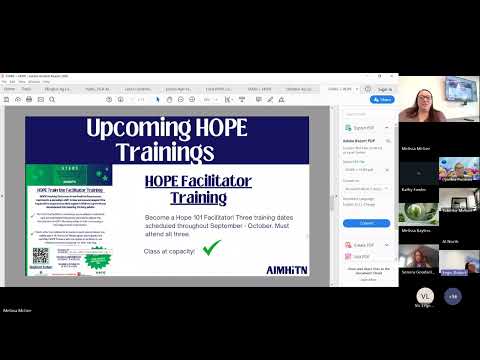
"If you haven't done a HOPE training yet, I highly recommend it," Sarah Judkins of Aim High Tennessee said, announcing upcoming HOPE 101 sessions on Sept. 13 and Sept. 18 and a HOPE consortium meeting on Sept. 11.
Representatives from the Regional Intervention Parent Program (RIPP) described a parent-peer model that integrates HOPE into staff training cycles, parent support groups and public presentations. RIPP said it served about 315 families through HOPE-related activities and reached roughly 500 professionals at conference presentations, and emphasized that all listed HOPE services are provided free of charge.
Speakers described the HOPE National Resource Center's online learning hub (positiveexperience.org), Spanish-language HOPE 101 materials, facilitator certification (three guided sessions plus an exam), HOPE champions and a process for organizational HOPE certification that begins with leadership buy-in and an organizational self-assessment. Dr. Sege noted new partnerships to make HOPE materials eligible for CEU and CME credit through Boston Children's Hospital.
A brief role-play shown during the session illustrated a HOPE-informed intake: a home visitor asked a parent's name and pronouns, normalized optional answers, identified a parent's strengths and offered support and resources rather than judgment. Presenters said that approach can surface PCEs that providers can use to build rapport and to frame referrals or supports.
The meeting closed the morning session with logistical reminders and a lunch provided by the Nashville Food Project. The commission encouraged attendees to network and reconvene at 1 p.m. for a working discussion about next steps in Tennessee.
What happens next: presenters encouraged participants to register for listed HOPE trainings and to use the HOPE online hub for facilitator and organizational resources.