Get Full Government Meeting Transcripts, Videos, & Alerts Forever!
Get email alerts on the Child Abuse Prevention topic
No spam. Unsubscribe anytime.
Commission approves State Plan for Prevention of Child Abuse and Neglect after statewide outreach
Summary
The commission voted to approve the state prevention plan presented by the Oklahoma State Department of Health, which sets strategic areas for funding, coordination, family support and community engagement and calls for SMART goals and a Jan. 31 planning summit.
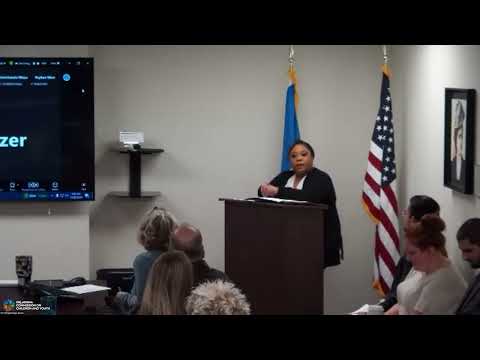
The Oklahoma Commission on Children and Youth voted to approve the State Plan for the Prevention of Child Abuse and Neglect after a presentation by Susie Gibson, program manager for the Office of Child Abuse Prevention at the Oklahoma State Department of Health.
Gibson told commissioners the plan resulted from statewide outreach including English and Spanish surveys and community cafes conducted across all 77 counties. The plan identifies five strategic areas: infrastructure investments and workforce development; alignment and coordination across systems; family support and resource connection; public awareness and engagement; and community action and empowerment. The office plans to set SMART goals, measure outcomes and use existing programs — such as family resource centers and Parents as Teachers — as building blocks rather than creating entirely new systems.
Gibson reviewed Oklahoma child-maltreatment data cited in the plan, including the statewide volume of accepted reports and age-related vulnerability. She said the office received survey responses from all 77 counties and will host a state planning summit on Jan. 31 at the Oklahoma Center for Nonprofits to form implementation committees and set measurable targets. Commissioners asked clarifying questions about outreach and the role of agency partners; Director Jacoby and others agreed the plan is intended as a living, implementation-focused document.
By statute the item required a vote; commissioners moved, seconded and approved the plan by roll call. Commissioners noted intent to partner on implementation and to ask agencies with operating responsibilities to engage in committee work.
Ending: The commission approved the plan and asked staff to distribute materials and invitations for the Jan. 31 implementation summit.