Get email alerts on the Strategic Plan topic
No spam. Unsubscribe anytime.
CareerTech board previews strategic plan with enrollment, credential and apprenticeship targets
Summary
CareerTech staff presented a first-look strategic plan that sets multi-year targets for enrollments and credentials, outlines a new apprenticeship initiative moved from the Department of Labor, and previewed budget requests tied to those goals.
CareerTech leaders on the board’s first-look review outlined a strategic plan that sets growth targets across multiple delivery arms and seeks state funding to deliver them. The agency said it aims to grow total system enrollments, increase industry-endorsed credentials, expand work-based learning and scale new apprenticeship models over the next five years.
Gina Hubbard, director of statewide outreach, said the agency is targeting 15% system growth by 2029 and a 10% increase in industry-endorsed credentials in the same period. Hubbard noted a recent decline of 2.75% in industry credentials—"that equals about 621 credentials"—and said staff need more time to analyze whether students are leaving programs early because local employers hire them before completion.
Max McKnight, director of workforce training, told the board the agency reported roughly 1,371,000 contact hours of customized and safety training systemwide in FY24 and described two funding buckets for employer training: a 1.2 formula for current-employee training and a 1.4 incentive for new or expanding employers.
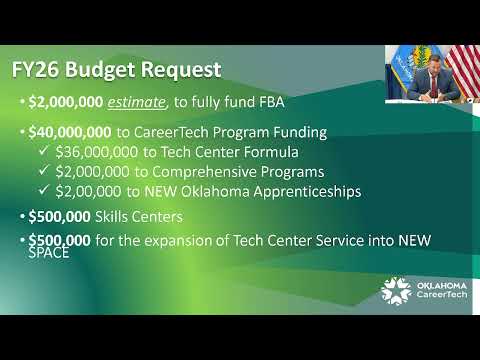
The board also reviewed plans to take over statewide apprenticeship leadership from the U.S. Department of Labor under a recently awarded grant. Staff said two Department of Labor apprentice specialists will transition to the agency in September and that CareerTech will operate both registered DOL apprenticeships and an Oklahoma-specific, stackable apprenticeship model with a 600-hour minimum. Agency representatives said the legislature provided $1.5 million in one-time funds for apprenticeships and the agency is preparing a recurring request of about $2.0 million to scale the program.
Officials flagged several follow-up items for the board: a return-on-investment study being completed with a university partner to inform tuition and program decisions; a deeper dive into the credential decline; and more granular enrollment and wait-list data from technology centers to refine funding requests.
The presentation was framed as a first look. Board members asked for slide-by-slide pauses for questions and encouraged staff to return with more detailed analyses before any formal votes on policy or funding.
AI generated
The text on this page is AI generated. Summaries, highlights, analysis, and video transcripts are all produced from the original source material.
AI can make mistakes, so if you spot one, and we will fix it for everyone.
Note: the source content is unaltered by us. Any content source we link to, be it a video, an audio recording, or a document, is presented exactly as its publisher released it. That publisher is usually a government body, sometimes an individual official or another organisation.