
State board reviews accreditation process and approves skill center accreditations
Get AI-powered insights, summaries, and transcripts
Subscribe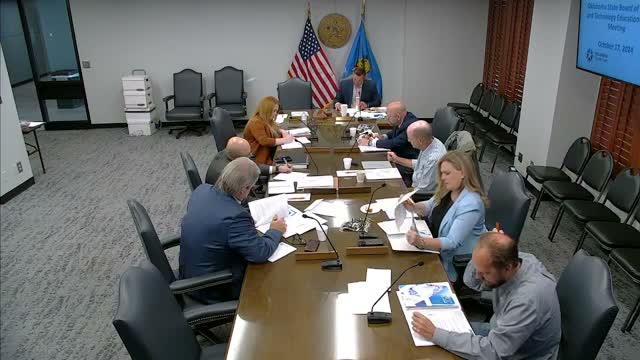
Summary
The Oklahoma CareerTech state board received its annual accreditation training, heard details about the accreditation cycle and examiner procedures, and voted to approve full accreditation for 16 skill center programs (including programs run inside correctional facilities).
Jessica Ventress, director of academic affairs, opened the board’s annual accreditation training and walked members through the agency’s accreditation process, the seven standards the board uses to assess quality, and how accreditation affects student financial aid eligibility.
"We look at leadership and administration, instruction and training, support services, measurement analysis, personnel, operations, and system impact," Ventress said, describing the standards the board approved when the process was established. She also explained that examiner teams complete online and virtual training, conduct virtual group interviews followed by on-site observations, and produce feedback reports that include average scores, strengths and opportunities for improvement.
Ventress said 28 technology centers participate in the accreditation process and a little over 3,000 students received Pell last year. She described corrective-action timelines (agency staff said any corrective action must be implemented within 60 days of board approval) and said the agency continues hybrid visits and three-year monitoring for continuous improvement.
Board members asked operational questions about examiner logistics and whether local communities could be engaged when long teams travel to a host town; a board member suggested inviting chambers or community hosts to share CareerTech successes when examiners are in town.
Following that discussion, the board considered accreditation findings for the system’s skill-center programs (16 programs, many located in Department of Corrections facilities). Staff recommended board approval of the accreditation actions brought in the report. A motion to approve the skill-center accreditation was moved, seconded and carried on a roll-call vote; the board recorded affirmative votes and the chair declared the motion passed.
The board will receive the examiners’ feedback reports after the first of the year and staff said they will continue to invite board members to observe visits in their areas. The agency also noted that the expansion of scope to accredit distance education programs remains limited to lecture-type offerings; all lab and hands-on instruction remains on-site and approved distance programs become part of institutional accreditation once the board approves them.