County unveils CLP+ findings: large unmet need, workforce and data gaps drive recommended system changes
Summary
Health department and epidemiology staff presented the Comprehensive Local Plan Plus, finding sizable unmet substance-use treatment need (presentation cited ~7,000 youth and ~27,000 adults not receiving needed care), recommending workforce pay improvements, culturally-specific services, centralized data and a deputy strategy role; county will review CLP+ with CCO partners next week.
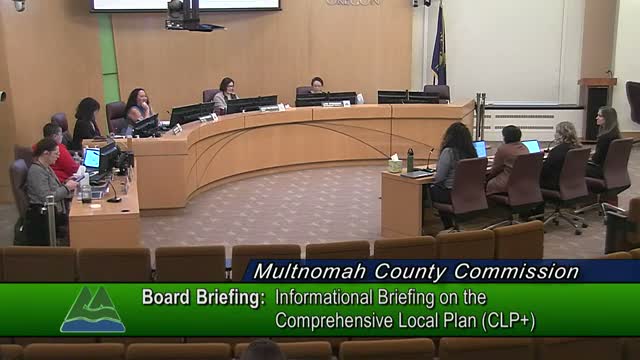
Health Department Director Rachel Banks introduced the county’s Comprehensive Local Plan Plus (CLP+), a research-driven update to Multnomah County’s behavioral health planning that aims to move the county from assessment to prioritized action.
Emily Macaitis, epidemiology manager in the Public Health Division, summarized a crosswalk of 12 prior needs assessments and a 2024 capacity analysis using the CAST (Calculating an Adequate System Tool) framework. Macaitis said the analysis estimated gap figures showing thousands of people with unmet substance use disorder treatment needs: "For youth, over 7,000 people were estimated to need treatment but not receive it. For adults, almost 27,000 people were estimated to need treatment but not receive it," she said, clarifying these numbers are derived from survey-based prevalence estimates and modeling rather than direct service counts.
Dr. Rachel Solitaroff, an external reviewer, reported findings from an organizational-design review of the Behavioral Health Division: "The strategy of the behavioral health division is fragmented, described by some even as a strategic vacuum," she said. Solitaroff flagged leadership siloes, high turnover (multiple leaders in recent years), the division’s strong focus on direct service delivery without a clear strategic lens for which services to retain in-house, and a pervasive hunger for actionable data among staff and partners.
Presenters and provider partners prioritized several near-term and structural actions: build workforce pipelines and address wages to improve retention; invest in culturally and linguistically specific services and payment parity; redesign reimbursement to cover housing and wraparound supports; expand youth prevention and school-based services; and create a centralized data system with real-time information on capacity and eligibility. Heather Mirza, Director of Behavioral Health, emphasized Multnomah County’s role as convener and the need to shift from planning to action.
Solitaroff recommended a new deputy-level strategy officer position focused on population health, data-driven decision-making and cross-agency coordination, while urging governance reforms to make strategic choices explicit and accountable. Presenters cautioned that data are imperfect — providers responded to surveys at a 60% response rate and some inputs were filled from 2022 sources — but argued the analysis provides a pragmatic launch point for prioritized system change.
Board members thanked staff and said the briefing should continue next week with CCO partners and more time for commissioner questions. Rachel Banks and staff will circulate the CLP+ materials this week and return with a jointly developed action agenda. "We can't afford to delay any longer in finding and implementing answers to these pressing issues," Heather Mirza said.
Next steps: CLP+ to be shared with commissioners this week; a joint presentation with coordinated care organizations is planned for the following meeting to present committed priorities and an accountability structure.