Get Full Government Meeting Transcripts, Videos, & Alerts Forever!
Get email alerts on the Environmental Risk Management topic
No spam. Unsubscribe anytime.
County deliberates strong financial-assurance ordinance for CEI Hub; amendments pass but first reading fails
Summary
Commissioner Myron sponsored an ordinance to require financial assurance (risk bonds) for facilities in the Critical Energy Infrastructure Hub. After extensive invited testimony and public comment, board amendments aligning parts of the draft with Washington state's approach were adopted, but the first reading of the ordinance failed on a 2-2 vote; commissioners voiced divided views on timing, penalties, caps and enforceability.
The Multnomah County Board considered a first-reading ordinance that would require certain facilities in the Critical Energy Infrastructure (CEI) Hub to demonstrate financial assurance to cover costs and damages from large fuel releases, including those resulting from a Cascadia-scale earthquake.
Commissioner Myron introduced a set of amendments to align the county's draft with Washington state's risk-bonding approach. Key amendment elements adopted on the motion included a per-barrel multiplier for calculating assurance, an upper cap on financial assurance, and an increase in civil penalties for violations in the red-line version posted to the county website. Supporters framed the measure as a polluter-pays approach to protect communities, tribal resources and the Willamette River from catastrophic releases; environmental and public-health experts urged a higher per-barrel multiplier, elimination of a $300 million cap and higher daily civil penalties, and asked for a faster effective date.
Invited invited testimony came from river and health advocates, including Portland Harbor Community Coalition, Oregon Physicians for Social Responsibility and the Center for Sustainable Economy. They cited published county studies and outside analyses estimating damages from a catastrophic release and urged no cap on assurance, a higher per-barrel calculation in line with BP Horizon analogies, and penalties at $25,000 per day.
Industry and working-waterfront stakeholders asked for alignment with federal and state liability frameworks, more time to verify operational data, and assurances the county had analyzed how federal funds and existing liability mechanisms (Oil Spill Liability Trust Fund, OSLTF) would affect shortfalls. The Portland Metro Chamber and business groups asked that the policy be developed with state and federal partners.
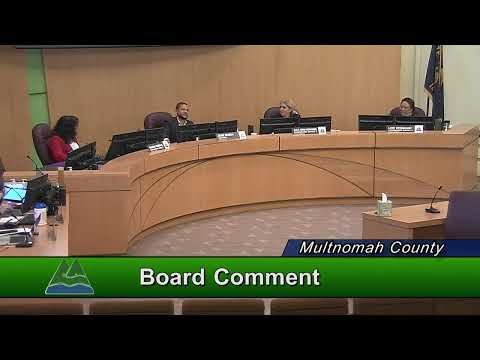
After extended debate, the board voted on the package of amendments. The roll-call vote on the amendments passed with Commissioners Myron and Brem Edwards voting aye and Commissioners Stegman and Vice Chair Beeson voting no/negative; however, on the formal first reading of the ordinance the same 2-2 split meant the first reading failed and the ordinance will be returned for further work. Commissioner Myron said she would bring the ordinance back for a future vote.
Next steps: The sponsor indicated she will reintroduce the ordinance; staff and commissioners asked for additional analysis on implementation, fund-access procedures, whether insurance products are available, the role of state/federal programs, and potential exclusions (self-insurance, captive insurance) before a final ordinance is adopted.