Get Full Government Meeting Transcripts, Videos, & Alerts Forever!
Get email alerts on the Tents Tarps Policy topic
No spam. Unsubscribe anytime.
County debates interim tents‑and‑tarps distribution policy as joint office reports near‑capacity shelters
Summary
After the micro‑village briefing commissioners discussed an interim county tents‑and‑tarps distribution policy, pressing Joint Office staff for shelter capacity data, accountability measures for outreach distribution, and city–county coordination ahead of an April policy review.
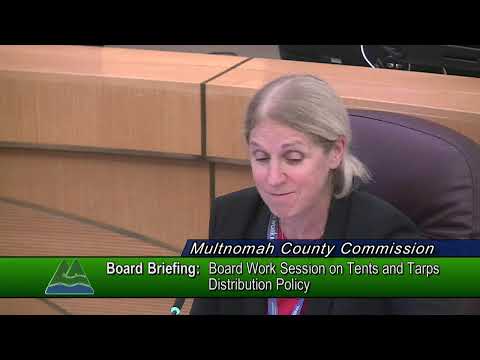
Following the micro‑village briefing, Multnomah County commissioners held a work session on an interim tents‑and‑tarps distribution policy and the county’s pandemic‑era supply center. Stacy Bork, deputy chief of staff to the chair, summarized the policy history and said the interim policy (adopted in October) sets coordinated distributions by outreach zones, provider agreements and data tracking.
Dan Field, director of the Joint Office of Homeless Services, told the board current shelter capacity is just under 2,800 units (2778, excluding a ramping‑up site) and that nightly shelter utilization regularly runs 90–93 percent. Field said the Joint Office framed the policy as an interim measure while the community shelter strategy is implemented.
Commissioners raised concerns about accountability and neighborhood impacts. Commissioner Prim Edwards urged the Joint Office to provide more detailed, actionable recommendations and evidence to inform policy, and to incorporate community‑impact testimony gathered by the city council. "The policy should be evidence and data informed and coordinated with all the cities and counties," Edwards said.
Several commissioners asked how the county will ensure providers who receive county‑supplied tents and tarps follow written practices — for example, counseling recipients about applicable local time, place and manner rules, discouraging camping in sidewalks or other public rights of way, and avoiding blocked passage. Dan Field said staff added references to relevant court decisions and the city’s time, place and manner provisions to emphasize community concerns and planned an April review to assess implementation.
Other commissioners framed tents and tarps as a harm‑reduction, life‑saving measure and cautioned against abruptly halting distribution without alternatives. Commissioners also requested mapping of where public land is designated for camping and more transparent accounting of which organizations access the county supply center and what they distribute. The board asked the Joint Office to provide follow‑up data on outreach coordination, distribution recipients, and shelter availability ahead of the April policy review.
The board did not vote on a change; the interim policy remains in effect as staff and commissioners continue to refine reporting and enforcement coordination.