Get Full Government Meeting Transcripts, Videos, & Alerts Forever!
Get email alerts on the Environment Energy topic
No spam. Unsubscribe anytime.
Multnomah County previews ordinance to require fuel-hub operators to post financial assurances
Summary
County staff and neighbors urged a draft ordinance to require financial assurance from operators at the Critical Energy Infrastructure (CEI) Hub to cover cleanup, response and public costs after a catastrophic spill; staff said the draft aligns with state seismic rules and is open for public comment.
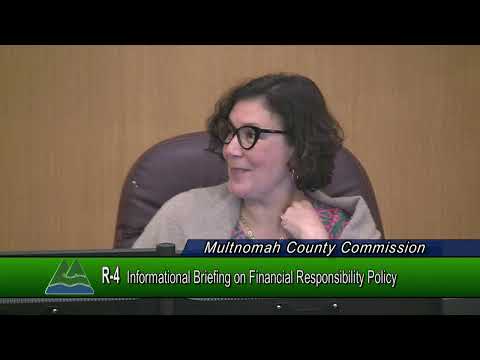
Commissioner Myron on Thursday introduced a draft financial responsibility ordinance that would require operators of large storage facilities in Multnomah County—s Critical Energy Infrastructure (CEI) Hub to show evidence of financial assurance for cleanup and public costs in the event of a spill or release.
The measure, presented at a board briefing, would apply to facilities with 2,000,000 gallons or more of storage capacity and would scale the required assurances based on a facility—s total capacity and its progress implementing the state—s Seismic Tank Stability Program. John Boschinski, the county—s sustainability director, said the draft allows operators to demonstrate assurance through insurance, a trust, a bond or a letter of credit and proposed administration of the program in the Office of Sustainability with one FTE and possible fee recovery for program costs.
The draft grew from neighborhood concerns and technical study of seismic vulnerability around the CEI Hub, Commissioner Myron said, noting that 90% of Oregon—s fuel supply is stored in the hub and that liquefaction and lateral spread make the site particularly vulnerable to Cascadia subduction-zone shaking. "We started to try to figure that out," Myron said, describing the goal as giving local governments tools to ensure companies can pay for damages so taxpayers and public entities are not left on the hook.
Speakers from Linton neighborhood organizations said the ordinance must cover accidents and restitution, and urged the board to set assurances at levels that would make communities whole after a catastrophic event. "It will make Linton feel less like a sacrifice zone," said Dorese Weller, a Linton Neighborhood Association board member, urging inclusion of damage restitution language and realistic dollar estimates tied to DEQ mitigation standards and Senate Bill 1567.
Industry representatives said they need time and stakeholder engagement to vet the concept. "Four weeks is simply not enough time to review a concept of a proposal," Sophia Steele of the Western States Petroleum Association told the board, requesting a longer stakeholder process and clarification about caps on coverage costs.
County emergency management staff highlighted the potential scale. Chris Voss, director of emergency management, cited county estimates that the hub holds roughly 350 million gallons of capacity and that a major Cascadia event could release tens to hundreds of millions of gallons. He warned that federal and state mechanisms, including the Oil Pollution Act and the Oil Spill Liability Trust Fund, may not provide sufficient or timely funds in a truly catastrophic scenario.
Board members asked about the 2,000,000-gallon threshold, potential economic impacts (for example, whether costs would be passed on to consumers) and the timeline for rulemaking. John Boschinski said the draft posted for public comment will be refined through the rulemaking process and that staff expect roughly an 18-month implementation period for rulemaking, staffing and procedures if the board adopts an ordinance.
The briefing concluded with a request for more technical detail on the formula that would set assurance levels and for a public outreach plan. Commissioner Myron said the draft is a starting point and that the county will accept written feedback and hold additional stakeholder engagement before any final action.