Get Full Government Meeting Transcripts, Videos, & Alerts Forever!
Get email alerts on the Public Safety topic
No spam. Unsubscribe anytime.
Curry County officials and residents spar over proposed five-year public-safety levy, call for audit
Summary
Commissioners, a citizen pro-levy group and residents debated a proposed 5-year, $1.12 per $1,000 law-enforcement levy that would fund additional patrol deputies and dispatchers; disagreements centered on which positions to fund, five-year sustainability, alleged timecard coding of patrol deputies working the jail and calls for a forensic audit before finalizing the ballot measure.
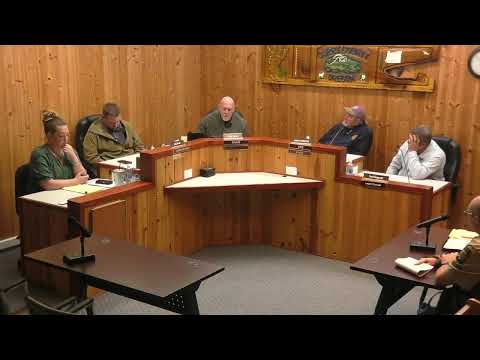
A Curry County workshop on Nov. 25 centered on a proposed five-year law-enforcement levy that would charge $1.12 per $1,000 of assessed property value to raise an estimated $4,280,910.11 in its initial year and to fund additional patrol deputies and dispatch staff.
Georgia, who led the presentation for the citizen group supporting the levy, told the Board of Commissioners the measure "would be a 5 year levy ... should the county levy $1.12 per thousand of assessed property value, be approved." She said the proposal is intended to fund eight patrol deputies and two dispatchers and that a five-member citizen review board would oversee levy expenditures.
County Clerk Shelley and staff explained the administrative steps and forms required to place the measure on the ballot, including submitting an SEL 805 (the initial measure notice) and, after the public-comment period, filing SEL 801. Staff noted a special-district election process means no state voters' pamphlet is produced and that any county communications to voters must be strictly factual.
Commissioners and staff parsed the levy’s financial mechanics. Finance staff presented a preliminary allocation showing the levy would free an estimated $1,253,258 in general-fund obligations (money the county currently pays for sheriff’s-office services) and would offset certain road-fund and marine allocations. Staff warned that long-term cost drivers — collective bargaining COLAs, PERS, health-insurance increases and equipment/training costs — could reduce the levy’s buying power over time. A finance projection shown at the meeting suggested the levy could break even in about three years under the assumptions discussed, with later years vulnerable to inflation and rising personnel costs.
A major point of contention concerned how many and which positions the levy would fund. Commissioners noted confusion between language that described "eight patrol deputies" and language that actually meant eight new staffed positions composed of five patrol deputies, one sergeant and two dispatchers. Staff clarified the intent and said they would correct the SEL 805 summary text and provide a flowchart and itemized budget to make the allocation explicit.
Several commissioners and staff raised operational concerns about where newly funded personnel would actually be deployed. Commissioners asked whether patrol deputies paid from road funds were being used to staff the jail (12-hour shifts), and whether deputies paid from road funds were being time-coded correctly. One commissioner said the problem warranted a deeper review, stating, "We need an audit of the sheriff's department so that we can make sure that these things are being done legally and accurately." Commissioners directed staff to collect schedules and timecards for the previous year to allow a review of coding and allocations; staff agreed to seek those records and one administrator said they could provide them quickly.
Public commenters and some commissioners urged a broader, longer-term approach to county revenue, arguing that the county’s permanent property-tax rate (noted in workshop discussion as 59¢ per $1,000) has not kept pace with costs and that raising the permanent rate or building a capital plan might solve structural budget shortfalls. A resident who identified herself as Miss Klein told the commissioners she could not support the proposed levy in its current form and urged more coordination with the sheriff and broader fiscal planning.
Other operational questions included recruiting risk (staff warned few applicants exist for open jail positions), whether a detective position would yield operational efficiencies by freeing patrol time, and whether the levy should explicitly fund courthouse security or correctional officers to provide more apparent benefits to city residents. Commissioners asked staff to prepare data on deputy workloads and unanswered calls to help determine whether adding investigative capacity would be a cost-effective use of funds.
Georgia committed to revise and resubmit the SEL 805 text to the BOC office by the agenda deadline and to produce a flowchart and an itemized budget summary for the next VOC/BOC meeting. Commissioners discussed deadlines to place a measure on a May ballot and expressed a sense of urgency if the board decides to move forward.
No formal motion or vote occurred at the workshop. The board directed staff to retrieve schedules and timecards for review, requested an itemized flowchart and cost breakdown to be provided before the next VOC meeting, and agreed to keep the levy discussion on the agenda. The workshop concluded with the chair thanking participants and adjourning.
Ending note: The levy proponents emphasized patrol and dispatch as the levy mission; several commissioners and public participants said they would like clearer, itemized cost information and independent verification of past timecard coding before recommending a ballot measure.