Get Full Government Meeting Transcripts, Videos, & Alerts Forever!
Get email alerts on the Arpa Funding topic
No spam. Unsubscribe anytime.
Harney County debates uses for remaining ARPA funds as fairgrounds boosters press for event center investment
Summary
At a Nov. 14 Harney County work session, officials reviewed allowable uses and timing for remaining ARPA funds and heard sustained public comment urging allocation to the county fairgrounds event center; other options discussed included buying a state‑leased building, vehicle purchases, landfill permitting and transfer to general‑fund lost‑revenue calculations.
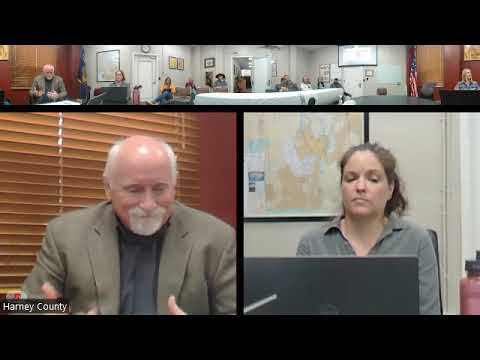
Harney County officials at a Nov. 14 work session reviewed how to obligate leftover American Rescue Plan Act (ARPA) funds before the Dec. 31, 2024 obligation deadline and heard public pleas to direct remaining dollars to the county fairgrounds event center.
The meeting opened with the chair reminding the group that ARPA funds must be obligated by Dec. 31, 2024 and expended by Dec. 31, 2026, and saying staff had contacted the National Association of Counties for guidance on the formula used to calculate replacement of lost revenues.
Why it matters: The county has limited time to commit funds and faces multiple competing priorities. Some ARPA categories — notably replacement of lost revenue, negative economic impacts and infrastructure tied to public health — allow broad uses, but officials said they are still awaiting clarifications to ensure expenditures withstand audit through 2032.
Public supporters of the fairgrounds outlined how the event center would serve multiple community needs. "This is a shovel ready project that's already off the ground," said Pierre Nair, chair of the fair board. Nair told the court that additional county investment would accelerate work and strengthen tourism and emergency‑shelter capacity.
Autumn Toley Jackson, secretary for the Harney County Livestock Show and Auction, provided participation and revenue figures to underscore the facility's local role: "Last year at the Fair, we had 179 youth registered — about 107 were 4‑H, 46 were FFA, and 26 were independent," she said. Jackson also cited auction totals of $578,619 in sales plus $98,630 in add‑ons, a combined $677,250 that she said circulates back into the county.
Supporters and several court members argued the fairgrounds investment could yield recurring annual revenue through more and larger events and could help the county secure additional state or private funding. One commissioner said prior ARPA money had helped leverage other projects: "There was a $175,000 donation to complete the kids club project that secured additional funding," staff noted, and the county also invested about $125,000 to restore solar to a public pool so it could operate and seek further grants.
Alternatives and constraints: Court members discussed several alternative uses and legal/administrative constraints. The chair raised the possibility of purchasing a state‑leased building currently occupied by a MiWay tenant so a private investor could install electrical and HVAC upgrades; officials noted the Oregon Department of Administrative Services and the Oregon Lottery each hold a half interest and that the state owners must receive fair market value. The chair said the building had been appraised about $300,000 roughly a decade ago and speculated a current appraisal might be $300,000–$400,000, with the Lottery due half of any sale price.
Not all members supported a purchase. One court member urged caution, saying the county already holds a favorable lease and the state is unlikely to vacate; staff also said they were not aware that a data center would clearly qualify under the broadband category.
Staff briefed the court on earlier ledger entries: roughly $160,000 had previously been designated as replacement revenue, and the county has spent about $83,000 on broadband projects. Officials said they are researching whether a recalculation of the replacement‑of‑revenue formula could free additional general‑fundable dollars.
Other spending ideas mentioned included buying law‑enforcement or assessor vehicles with ARPA funds (which can free general‑fund dollars elsewhere), courthouse door and alarm work (roughly $14,000 beyond a grant), jail planning and design expenses, and paying engineering costs to re‑permit rural landfills. On permitting, the county reported it had paid about $6,000 for a landfill plan and might need another $10,000–$15,000 for engineering to complete DEQ requirements.
Next steps: Because this was a work session, no final decisions were made. The chair said staff would gather additional guidance from NACO and other sources, refine the county's estimated allocations (the chair's "shopping list" included about $300,000 for the event center and roughly $170,000–$270,000 for other items), and present a formal proposal at the first county court meeting in December.
The court moved to adjourn at the end of the work session and voted in favor of adjourning.