Get Full Government Meeting Transcripts, Videos, & Alerts Forever!
Get email alerts on the Judiciary State Of The Judiciary topic
No spam. Unsubscribe anytime.
Nebraska Chief Justice Jeffrey Funk urges funding, touts probation gains and tech overhaul
Summary
Chief Justice Jeffrey Funk told the Legislature that probation programs and problem-solving courts are reducing recidivism and costs, but the judicial branch needs new funding and a case-management modernization supported by a $1.7 million planning grant to sustain progress.
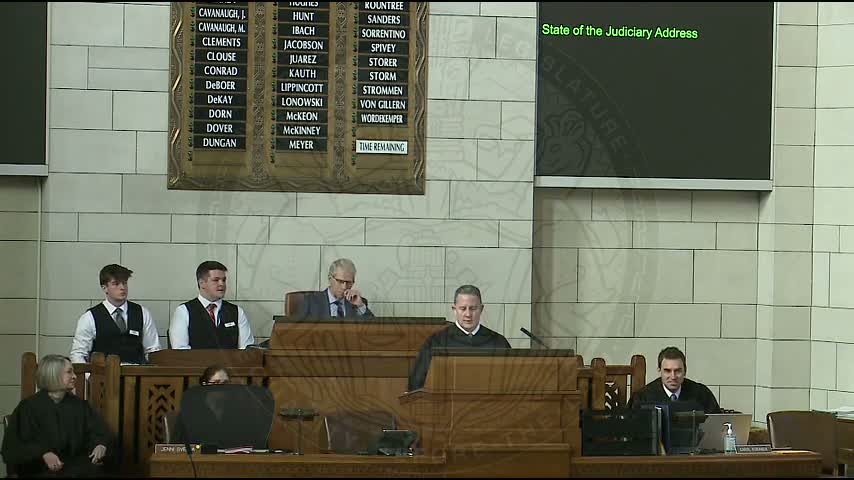
Chief Justice Jeffrey Funk delivered the State of the Judiciary address to the Nebraska Legislature, praising probation and problem-solving courts for lowering reoffending while urging lawmakers to provide adequate funding for the judicial branch in the next biennium.
Funk told senators that adult probation supervises more than 14,000 Nebraskans and that "the recidivism rate for those successfully completing probation is an exceptional 19%." He said problem-solving courts now serve more than 800 participants, with a 24% recidivism rate among graduates, and that juvenile probation caseloads have fallen substantially with a current recidivism rate of 17%.
The chief justice framed those results as cost-effective alternatives to incarceration: "The average cost of incarceration in Nebraska is $41,000 per person per year. The average cost of adult probation is $35,100 per person per year," he said. He also noted that Nebraska continues to have "one of the most overcrowded prison systems in the United States," and said prior criminal justice reinvestment efforts focused on diverting less serious felons to probation.
Funk highlighted several court initiatives that he said have improved access and efficiency: 17 community reporting centers that served more than 7,000 probationers last year; a pilot in-person self-help center in Douglas County for self-represented litigants; expanded language-access services with interpretation in more than 60 languages; infrared assistive listening devices in nearly every courtroom; and the Nebraska Judicial Electronic Exhibit System for digital evidence presentation.
On technology, Funk criticized the judiciary's aging case-management system, referred to in his address as "justice," which was implemented in 1994. He said the branch has launched a comprehensive review and secured a $1,700,000 grant to help design and build a replacement, calling it "justice 2.0," and warned that the branch will need legislative financial support to implement the modernization.
Funk identified behavioral health capacity and provider reimbursement as major constraints on sentencing alternatives and probation outcomes. He said more than 6,000 probationers accessed Probation's Financial Assistance Program for behavioral-health services in 2024, but that providers remain in short supply and reimbursement rates lag costs.
He thanked probation leadership and acknowledged the retirement of long-serving probation administrator Deb Menardi after 44 years of service. Funk also noted collaborative programs with the Department of Health and Human Services and partnerships with universities and the National Center for State Courts.
Funk closed by asking the Legislature to provide adequate funding for the next biennium to sustain gains in probation, problem-solving courts, language access, cybersecurity and the planned case-management upgrade.
The Legislature heard the address and then continued routine business and committee reports before adjourning.