Get Full Government Meeting Transcripts, Videos, & Alerts Forever!
Get email alerts on the LB290 topic
No spam. Unsubscribe anytime.
Bill would expand geographic eligibility for inland‑port grants in Omaha to limit displacement and increase options, proponents say
Summary
LB290 would remove a two‑mile airport restriction and require Economic Recovery funds be available to qualifying census tracts within an inland port authority area in Omaha; proponents said the change reduces displacement risk and gives grantees more site options amid a roughly $100 million project funding gap.
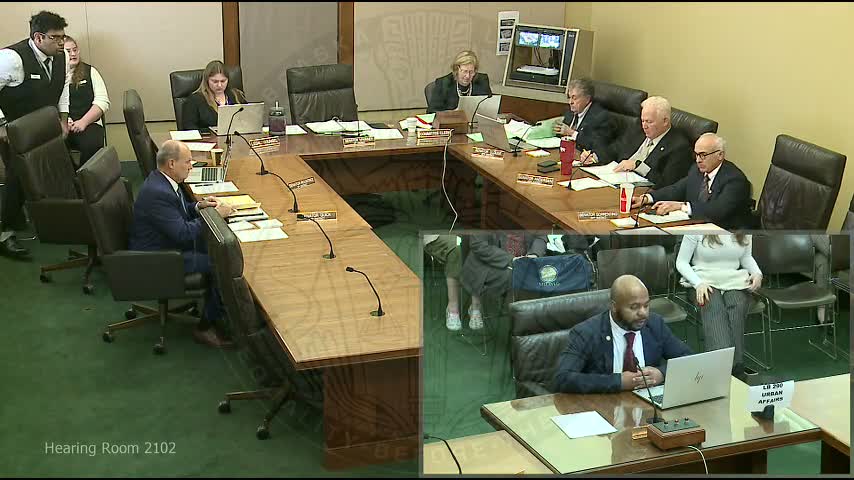
Senator Terrell McKinney told the committee LB290 would change grant eligibility so qualifying census tracts inside an inland port authority in a metropolitan city (Omaha) could receive funds, replacing a prior requirement that projects be within two miles of a major airport.
"This change is needed to provide flexibility for the current project because the issues in the area slated for development include environmental, potential displacement, and funding," McKinney said. He explained the inland port authority board asked for the change to allow another option that could avoid costly cleanup or displacement.
Jake Hoppe, a member of the Omaha Inland Port Authority and a real estate developer, said the two‑mile constraint overly limited available sites and that predevelopment work (community advisory board, advisory contracts, site diligence) has started. "The intent was not to then look at sort of the north downtown of Omaha, but keep it in the North Omaha community," Hoppe said.
Daviell (Daviell) Phillips, vice chair of the Inland Port Authority and an architect, said the Authority boundary covers about 3,000 acres with roughly 2,000 acres of buildable land and that expanding the eligible geography could reduce residential displacement and improve transit access for potential workers.
Committee members asked for a map; McKinney said he would provide a printed map of the current Inland Port Authority area. Senators and witnesses also discussed how funds were originally federal but were swapped and are now state funds; the sponsor said the project currently shows a roughly $100,000,000 gap while the legislature has committed about $90,000,000 to the project. McKinney noted the Inland Port Authority board had voted to award a predevelopment grant to grantees to advance site refinement.
Supporters urged the committee to allow flexibility so limited dollars are used to advance viable sites and to minimize displacement risks. No committee vote was held at the hearing.