Get Full Government Meeting Transcripts, Videos, & Alerts Forever!
Get email alerts on the Foreign Owned Land topic
No spam. Unsubscribe anytime.
Nebraska senator advances technical fixes to foreign‑owned real‑estate law, clarifies tribal and federal references
Summary
Sen. Barry DeKay introduced LB7 to tidy last year’s foreign‑owned real estate law: it clarifies that federally recognized tribes are not treated as foreign governments, updates federal regulation citations (15 CFR 791.4), adds CFIUS references for exemptions and would notify the Legislature of court‑ordered divestments; tribal and farm groups supported the clarifications.
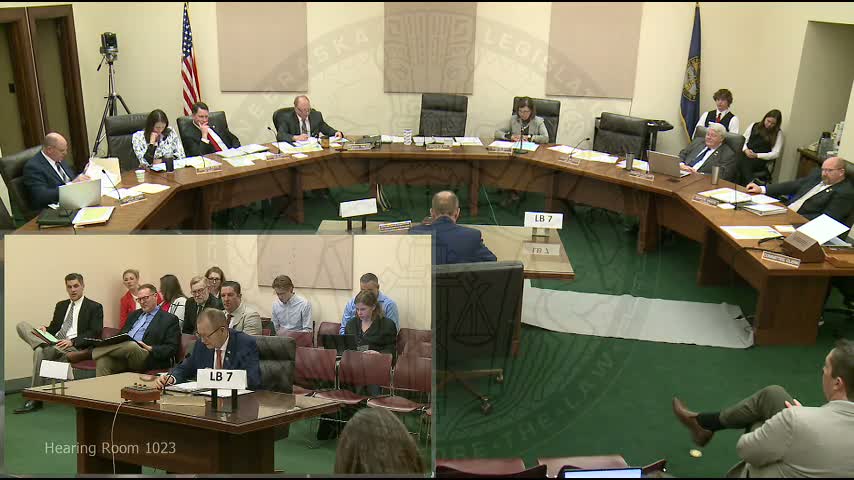
Senator Barry DeKay (chair, Agriculture Committee) introduced LB7 as a technical cleanup to last year’s Foreign Owned Real Estate National Security Act and related bills. He told the committee the bill “does 4 things,” including explicitly defining Native American tribes so they are not treated as foreign governments, updating federal regulation citations to reflect a moved rule (now cited as 15 CFR 791.4), adding precision around Committee on Foreign Investment in the United States (CFIUS)‑reviewed exemptions, and requiring legislative notice when a court orders divestment under the act.
Supporters from Nebraska tribes, farm groups and industry said the changes remove unintended consequences and reduce title and litigation risks. Kent Rogert (Ponca Tribe) thanked DeKay and urged the committee to move the bill to general file. Joey Adler Ruane (lobbyist for the Winnebago Tribe of Nebraska) described language to define “foreign corporation” so federally recognized tribes are excluded. Hannes Zetsche, a real estate attorney with Baird Holm, said clients feared the earlier statute’s definitions could “inadvertently prohibit[] their American entities from holding Nebraska cropland,” noting common uses of out‑of‑state LLCs by Nebraska farmers.
DeKay said the changes were informed by an interim review and consultations with the attorney general’s office and the executive branch. He described AM25 as cleanup language that would ensure the clerk of the Legislature receives notice of divestment actions and would more precisely define “foreign corporation.” AM68 would identify CFIUS‑accepted foreign states (Australia, Canada, the United Kingdom, New Zealand) as exempt from parts of the act unless an entity is otherwise restricted.
Nick Grange Net (identified in the transcript as a staff attorney) testified neutral and recommended additional clarifications to avoid inadvertently including immigrants who have temporary immigration statuses such as advanced parole; he suggested considering LB476, which addresses related scenarios. Committee members asked whether the bill changed enforcement or penalties; Senator DeKay and proponents said LB7 is intended as a technical harmonization that preserves the statute’s original enforcement framework.
The committee recorded two online letters in support, no opponents and no neutral letters for the oral record. DeKay closed by offering to work with colleagues on concerns and questions.
If advanced, the bill would modify statutory definitions and cross references; no formal vote was taken in the hearing.