Get Full Government Meeting Transcripts, Videos, & Alerts Forever!
Get email alerts on the Vaping Enforcement topic
No spam. Unsubscribe anytime.
Perkiomen Valley committee weighs stricter vaping language, detection tech and canine searches
Summary
Committee reviewed tobacco/vaping policy 02/22 and search policy 02/26, discussed defining prohibited devices (electronic delivery systems regardless of nicotine), cross‑referencing controlled‑substances policy for edibles, and considered using vape detectors, cameras and police canines as enforcement tools; administration will return more data and recommendations.
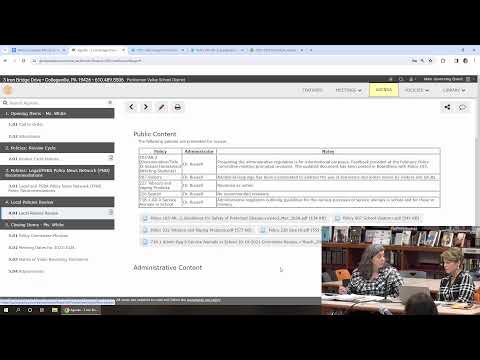
Perkiomen Valley School District officials used the March 19 policy meeting to examine enforcement and wording around vaping and search procedures after parents and board members raised concerns about incidents in school restrooms.
Administration presented policies 02/22 (tobacco and vaping) and 02/26 (searches). Committee members recommended clarifying that policy language targets the device (electronic nicotine delivery systems) and not only products containing nicotine, since devices on the market may deliver other substances. Members discussed cross‑referencing Policy 227 (controlled substances) for edibles and asked administration to consult PSBA and update archaic product references (for example, to early‑generation brand names).
On enforcement, speakers described a mix of measures: one‑off vape detectors trialed in a restroom, camera coverage of bathroom entryways, Safe Schools reporting data, and standard incident documentation. Administration said the district had conducted a trial of a vape detector and that security and safety staff will present more detailed findings at an upcoming safety and operations meeting. One administrator said sensors "send a message to administration when they detect the vape in the bathroom" and that administration would then review camera footage and respond.
The committee examined the legal and logistical contours of using police canines. Administration cited advice from the Pennsylvania State Police that canine searches are limited by court rulings to common areas and lockers and cannot be used inside classrooms; members suggested conducting random, minimally intrusive sweeps in hallways/lockers or external perimeter checks as a milder first step. Costs, implementation logistics, and the role of school police officers were listed as open items for the April board discussion.
Members also debated consequences for possession versus use; some favored aligning possession and use penalties, while administration noted the code of conduct and handbook already specify tiers of consequences (e.g., three days ISS for use as described in the handbook). Administration agreed to bring updated policy language and enforcement data back to the committee and to present technical details about detectors and canine‑search options to the full board.