Get Full Government Meeting Transcripts, Videos, & Alerts Forever!
Get email alerts on the Legislative Rules topic
No spam. Unsubscribe anytime.
Senate rejects bid to remove 20-bill limit; adopts permanent rules package
Summary
Nebraska senators debated removing a 20-bill introduction cap but defeated the amendment on a roll call (16–31). The Legislature then adopted a package of permanent rules as amended; a subsequent motion to reconsider failed.
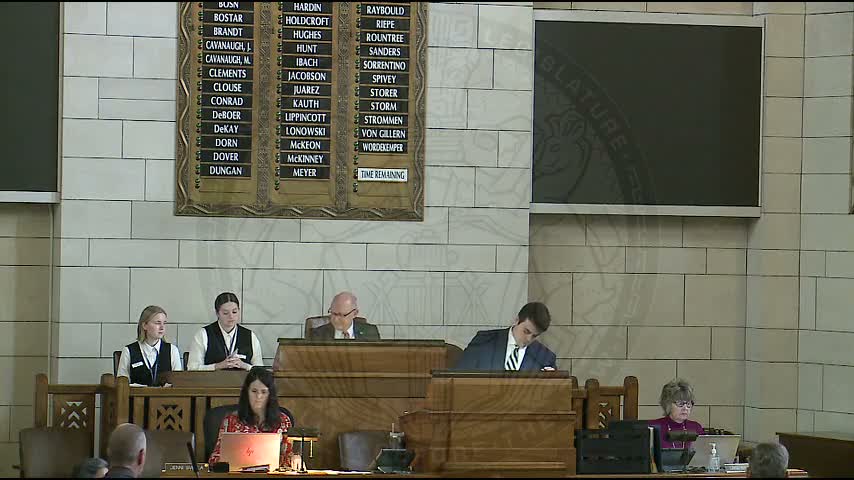
LINCOLN, Neb. — Senators debated whether to eliminate a 20-bill limit on individual bill introductions before rejecting the proposal and moving forward with a package of permanent chamber rules.
Senator Terrell McKinney proposed amending Rule 5, Section 4, to remove the limit on the number of bills a senator may request during a session, arguing the cap restricts senators’ ability to respond to constituents. “We should be working for the people of Nebraska, and that's why this bill limit needs to be taken away,” McKinney said, framing the change as necessary to avoid packing multiple proposals into omnibus "Christmas tree" bills.
Supporters, including Senator Mikaela Kavanaugh, told colleagues the limit gives the governor an outsized procedural advantage and constrains senators’ power to compel agency engagement. Kavanaugh said she introduced 20 bills this year and described introduction as a tool to secure agency participation: “If we are limited in what we can introduce, we are limiting our ability to engage with the state agencies that will not come in to meet with us otherwise,” she said.
Opponents said the limit helps preserve floor time and committee capacity and pointed to other states’ lower caps. Senator Ben Hansen warned that adding more introduced bills would increase committee hearings and reduce floor time for substantive debate, saying trend lines that show fewer bills this session suggest the rule could be achieving its intended effect.
After extended debate and a formal "call of the house" to ensure absent members returned, the clerk conducted a roll-call vote on McKinney’s amendment. The clerk announced the tally as 16 ayes and 31 nays; the motion failed.
The chamber then proceeded to the broader question of adopting permanent rules for the biennium. Senator Lippincott moved to adopt the permanent rules as amended by the rules committee. Senators asked the clerk to clarify how the adopted changes would be reflected on the board and in the journal, including the mechanics for members filing conflict-of-interest statements to be recorded as "present not voting" on final-passage votes. The clerk explained that, under the adopted language, present-not-voting would not be available for cloture votes on final reading or for the final passage vote unless a properly filed conflict-of-interest form is on record.
The clerk reported the adoption vote on the permanent rules package as 33 ayes and 6 nays, and the motion was adopted. Senator Mikaela Kavanaugh subsequently moved to reconsider the rules-adoption vote; the clerk reported 13 ayes and 28 nays on that motion, which failed.
The Legislature adjourned until Monday, Jan. 27, 2025, at 1 p.m.
What happened next: Implementation details raised on the floor — including when a member must file a conflict-of-interest form to avoid having the presiding officer show a different final vote on the board — will be handled administratively by the clerk’s office and may affect how members register objections on future final readings.
(Reporting includes direct quotes and vote tallies announced on the floor.)