Get Full Government Meeting Transcripts, Videos, & Alerts Forever!
Get email alerts on the Mill Creek Watershed topic
No spam. Unsubscribe anytime.
Commissioners press for stronger oversight after watershed concerns, schedule public hearing on Florence landfill
Summary
After months of citizen pressure, Alachua County staff outlined steps to protect the Mill Creek Sink watershed and confirmed a public meeting to discuss the Florence landfill in January 2025; staff said it will seek code changes, expand monitoring and coordinate with city and water‑management officials.
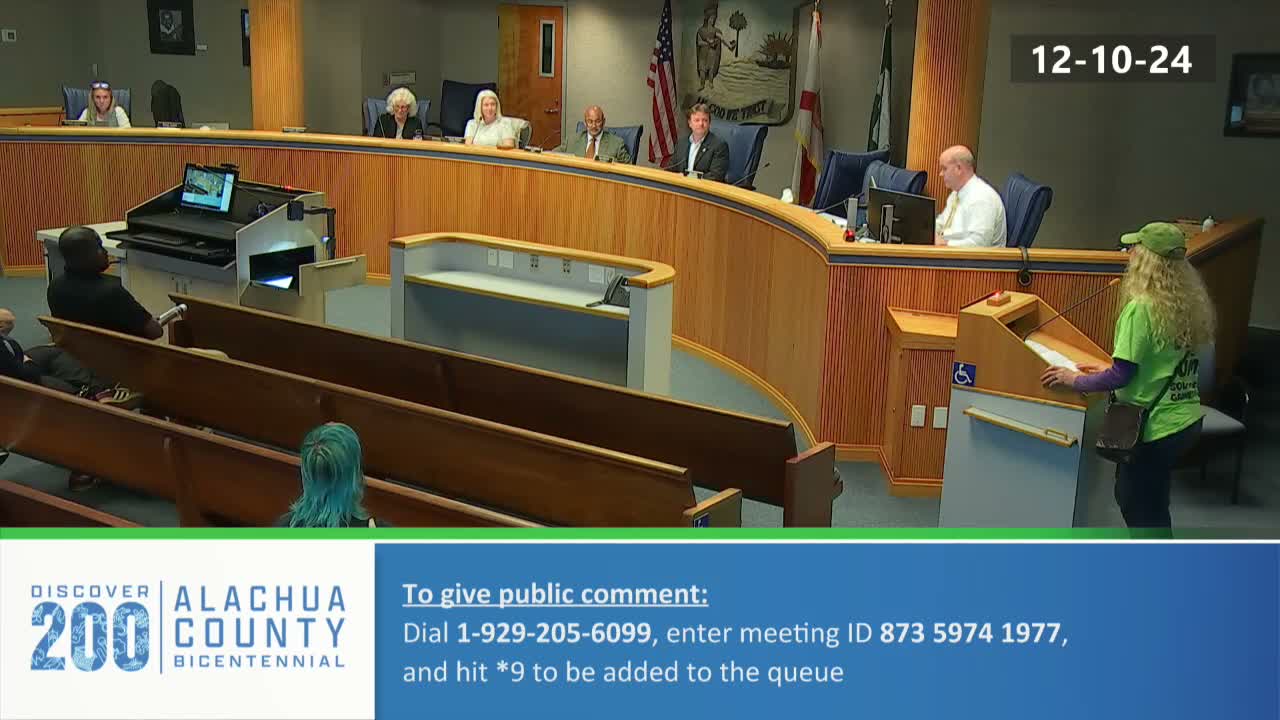
Residents and environmental advocates pressed the Alachua County Commission Dec. 10 to move quickly to protect the Mill Creek Sink watershed and address contamination and nuisance complaints tied to the Florence landfill.
Sara Younger of the Suwannee‑St. Johns Group of the Sierra Club commended recent county resolutions and urged continued action to strengthen stormwater quality codes, end self‑certification for developers, and consider land acquisition within the watershed for conservation. Multiple residents told commissioners they have smelled hydrogen sulfide and reported groundwater and drinking‑water concerns.
Environmental Protection staff presented a status update on a 14‑point motion the commission adopted in October. Staff said they are attending relevant City of Alachua hearings, sharing documents and workshop notices between county growth‑management and EPD staff, developing recommendations to tighten stormwater and comp‑plan language, and lining up technical experts to review proposed stormwater plans for projects in the Mill Creek Sink drainage area. The county also sent chair letters to the city of Alachua and to the Suwannee River Water Management District on Oct. 15 describing the county’s concerns and asking for additional review.
"We are bringing back code and comp‑plan language suggestions this spring," said the EPD presenter, summarizing a multi‑pronged plan that includes consultant engagement, stronger intergovernmental agreements and continuous monitoring recommendations.
Commissioners also confirmed the Florence landfill (commonly raised by public commenters as the "dump") will be placed on the Jan. 14, 2025 regular meeting for an evening forum at 5 p.m.; commissioners said they could move it to Jan. 28 if scheduling or public availability requires. Multiple residents asked that the county institute continuous air and dust monitoring, restore paused groundwater sampling and pursue drywall diversion options to reduce hydrogen‑sulfide complaints.
Several commissioners expressed support for investing in continuous monitoring equipment and for pursuing interlocal and regulatory changes to prevent development practices that threaten sink‑hole and karst features. Staff said they will present draft recommendations, including possible ordinance changes and options for expanding the county’s effective‑party status at municipal hearings, in spring 2025.
Ending: County staff will provide more detailed recommendations this spring and has scheduled a public hearing in January to gather community input about the landfill; the county said it has set aside legal reserves should enforcement or litigation be required.