Get Full Government Meeting Transcripts, Videos, & Alerts Forever!
Get email alerts on the Tax Abatement topic
No spam. Unsubscribe anytime.
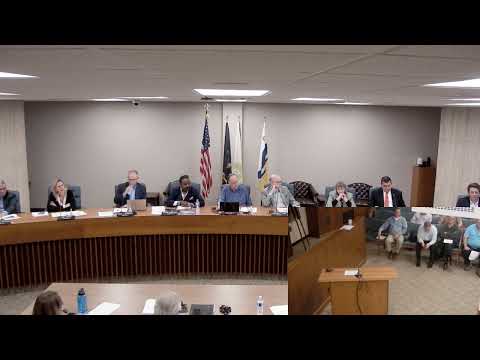
St. Joseph County Council rejects repeal of tax-abatement ordinance, 5-4
Summary
The St. Joseph County Council voted 5-4 to defeat Bill 109-24, which would have repealed the county's current property tax-abatement ordinance in favor of a simpler application process modeled on Mishawaka; debate focused on whether repeal would remove enforceable local-hire and community-benefit requirements.
The St. Joseph County Council voted 5-4 to defeat Bill 109-24, a proposal to repeal the county's existing property tax-abatement ordinance and adopt a Mishawaka-style application process that would rely on staff review and council discretion rather than detailed written criteria.
Proponents, led by Jeff Ray, president and CEO of the Southland Regional Chamber, told the council the ordinance is overly complicated for petitioners and that a form-based process would give staff and the council more flexible, efficient oversight. "What we've done is propose modeling this after Mishawaka," Ray said, arguing the model relies on staff recommendations and that Mishawaka only approves a few abatements a year. He said the change would make the process easier for petitioners and would not necessarily open the "floodgates" to more requests.
Opponents — including union leaders, contractors and residents — said repealing the ordinance would remove enforceable incentives for local hiring and community benefits. James Gardner, senior representative for Operating Engineers Local 150, warned against "open[ing] the floodgates" to out-of-town labor and urged the council to keep or revise written local-utilization language. "This is not a union, nonunion issue," Gardner said. "We are coming here to tell you to support local workers, vendors, and employers."
Several council members questioned the process that produced the March draft and whether the county's economic-development staff had been fully engaged in drafting revisions. One council member recounted voting against a similar ordinance on March 12, 2024, and said he had not seen the staff's suggested changes incorporated. Ray replied that he had provided written comments to staff and that there had not been agreement on final language, stressing that the proposal rescinds the current ordinance in favor of a staff-led application process.
Public comment at the hearing was extensive. Supporters of repeal said simplifying the ordinance would let small, nonunion local firms compete for work currently limited by the ordinance's criteria. Jonathan Wesco, a small-business owner, said the current ordinance can exclude local nonunion businesses from opportunities and urged modernization so more local firms can compete. Opponents — including representatives of the Carpenters Union and multiple local labor affiliates — urged the council to preserve enforceable local-hire criteria and to revisit the ordinance through a stakeholder-driven process that includes labor, business and department staff.
The motion to pass Bill 109-24 was made by Councilor Amy Drake and seconded by Councilor Randy Figg. After debate about whether simplicity for business would come at the cost of shared community goals, the council took a roll-call vote: Thomas: Yes; Drake: Yes; Shetzel: No; Martin: No; Figg: Yes; Hess: No; Catanzarite (listed in the record as Catanz/Wright): No; Tanner: No; Root: Yes. The motion failed 5-4.
Council members said next steps should include further review and stakeholder engagement. Several members — including those who opposed repeal — said they would support revising the 2009 ordinance if the process brought labor, economic-development staff, community groups and businesses together. The council then moved on to other business and adjourned.
Bill 109-24: motion to repeal the tax-abatement ordinance failed 5-4. No ordinance changes were enacted at the meeting.