Get Full Government Meeting Transcripts, Videos, & Alerts Forever!
Get email alerts on the Dewatering Permits topic
No spam. Unsubscribe anytime.
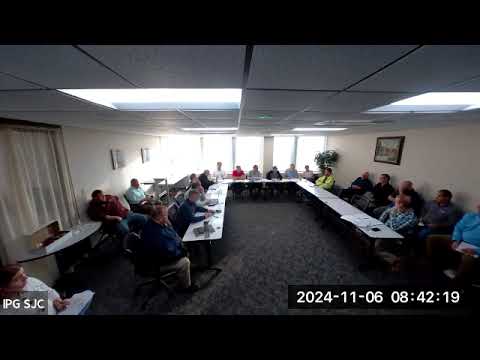
Drainage board approves multiple dewatering permits for large construction projects, requires monitoring and cleanup commitments
Summary
St. Joseph County Drainage Board approved several dewatering permits for construction projects including IEC3/AWS and CNE, imposing monitoring, throttling and maintenance conditions after hearing concerns about downstream sediment and ditch capacity.
The St. Joseph County Drainage Board on a motion approved a set of dewatering permits for multiple construction sites, including permits tied to the IEC3 (also referenced as ICE 3) development and CNE’s lift‑station work, and attached monitoring and maintenance conditions after substantial discussion of downstream impacts.
Board members considered applications that authorize peak discharges of up to 450,000 gallons per hour at individual sites and larger multi‑line discharges tied to the Smilax (Smilox) lift‑station work. One permit authorizes a south‑side State Road 2 discharge to operate between Dec. 3, 2024, and May 1, 2025, for a maximum of 43 operating days within that window. Other north‑side permits (including runs parallel to Larson Road/State Route 2) were approved with run‑time limits (for example, a 57‑day maximum on one north‑side permit) and an expectation that no more than two dewatering activities will operate concurrently.
Staff and applicants described sequencing constraints, utility conflicts and the need for bores and long discharge runs. CNE’s representative explained that a new lift station and a 24‑inch force main will require bores under and parallel to a railroad and may need as much as 12,000 feet of pipe to reach a suitable discharge point. Applicants said some work already began to maintain schedules and that substitutions (for example 53 limestone in lieu of recycled concrete) were made to accelerate construction timelines.
Hydrology and downstream impacts were central to the board’s deliberations. County staff and consultants summarized an H&H model that equated the aggregate permitted activity north of Gordon Road to roughly a two‑year storm event and noted the cumulative flows are a small fraction of a 100‑year capacity at the Gordon Road structure. Still, staff acknowledged the combined discharges will raise water surface elevations downstream and asked that permittees monitor effects on neighboring land.
A downstream landowner described significant sediment loads and sandbars in the Nesbajani Ditch, saying he logged thousands of pump hours this year and urging stronger erosion controls. County consultants and the board discussed mitigation approaches — including temporary check dams and additional ditch maintenance — but cautioned that structural fixes in the ditch may require Army Corps permitting. To address immediate concerns, permit approvals were conditioned on daily or frequent monitoring, installation of digital flow meters on discharge pipes and weekly synopses to county staff. Applicants (Walbridge/AWS representatives and a construction manager, Jeremy Robb) committed to provide monitoring data, daily photos, and to engage with the county on sediment mitigation; AWS representatives said they would work with stakeholders to mitigate and help fund downstream maintenance where appropriate.
Board members reserved the right to require throttling or temporary shutdown of discharge during heavy rain events and included language making permit approvals contingent on agreed maintenance: the county may arrange ditch cleaning (public bid) from the Kankakee River up to Johnson Road as needed, with costs to be addressed by the usual public‑bid process and potential contributions from project stakeholders. The board also asked that the Drainage Board and contractor coordinate weekly reporting of run times and discharge rates.
The approvals followed motions that were seconded and carried by voice vote. Next steps include implementation of the monitoring program, continued coordination with South Shore and rail property owners where bores are planned, and a follow‑up discussion this spring on longer‑term ditch remediation and culvert capacity near the Kankakee River.