Get Full Government Meeting Transcripts, Videos, & Alerts Forever!
Get email alerts on the Land Use topic
No spam. Unsubscribe anytime.
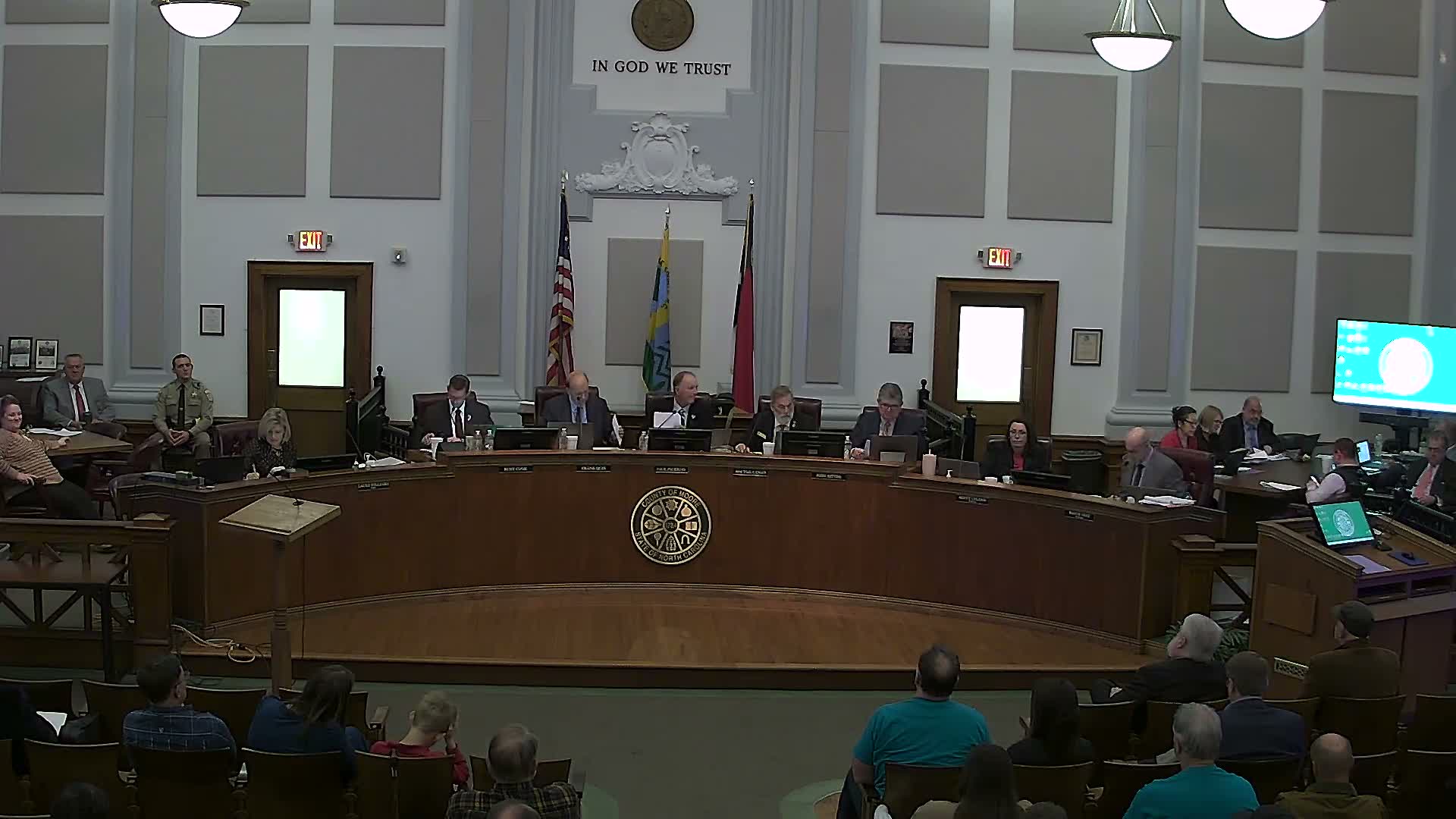
Moore County approves conditional rezoning for proposed URA Motorsports Park after nightlong hearing
Summary
After a marathon public hearing with more than 30 speakers, the Moore County Board of Commissioners voted 3–2 to approve a planned development conditional zoning for a proposed motorsports park on Leach Road, attaching voluntary conditions including sound limits, hours of operation, cemetery protections and traffic requirements.
The Moore County Board of Commissioners voted 3–2 on Nov. 19 to rezone about 395.7 acres on Leach Road from Rural Agricultural to Planned Development Conditional Zoning for an automotive entertainment facility proposed by URA Motorsports (often called the Autoport).
The decision followed hours of public testimony from opponents who warned the project would change the rural character of northern Moore County and supporters who said the park would bring jobs and business opportunities. Commissioners authorized the rezoning with a package of voluntary conditions offered by the applicant that include a sound limit at the property boundary, hours restrictions, cemetery protections, stormwater and traffic controls, and a requirement that track design meet FIA Level 2 safety standards.
At the hearing, opponents emphasized noise, traffic and environmental risks. Linda Jones, a nearby resident, told commissioners: "I don't support this rezoning… this project puts an incompatible land use … in an area whose character is the very opposite" (comment presented during public comment). Ecologists and local farmers warned about sedimentation and impacts to aquatic species in nearby tributaries. Jeff Marcus, a certified wildlife biologist, said the applicant’s federally focused species surveys did not address state-listed at-risk species and urged buffers and stronger stormwater engineering to protect mussels and downstream creeks.
Proponents, including applicants and partners, argued the park would generate local jobs, construction spending and small-business opportunities. James Forte, one of the four managing partners, said the project team is small and locally engaged: "We're not some big company. It's 4 of us," and added the developers want the park to be a community resource rather than an exclusive club.
The voluntary conditions read into the record and accepted by the board include: - A sound standard and monitoring program (the applicant proposed a cap of 75 decibels at any property boundary and specified mitigation tools such as earth berms, preserved or newly planted vegetation, sound panels and per-car sound checks); - Specific hours of operation for gas-powered and electric vehicles and kart track activity, with more restrictive Sunday start times (the board clarified start times and agreed Sunday operations would begin at 1 p.m. by board modification); - Preservation or coordinated relocation of an on-site cemetery with Moore/Montgomery County historical societies and family members; - Compliance with dark-sky lighting principles (UDO §7.8.q) and DOT recommendations in the traffic impact analysis; and - Design and operational standards tied to FIA Level 2 for the circuit and the option to seek up to two special-event hour modifications annually under existing UDO provisions.
After the applicant presented the mitigation package and a sound consultant described monitoring and test procedures, commissioners moved to a paper-ballot vote. The clerk read the results as 3–2 in favor: Chairman DeSerna, Commissioner Von Cannon and Commissioner Cook voted yes; Commissioner Frank Quiss and Commissioner Ritter voted no. The board directed staff to prepare the written rezoning document reflecting the voluntary conditions that the applicant must sign before site-plan review proceeds.
The vote drew immediate remarks from commissioners. The chairman said the applicant committed to mitigation that "will not be to a decibel level that should interrupt any of the adjoining properties" and cited county economic metrics and the limited acreage impacted as reasons for approval. Commissioners who opposed the rezoning said they were persuaded by neighbors' testimony about farmland preservation, traffic and the difficulty of enforcing long-term restrictions once a facility is built.
Next steps: the county will produce the written conditional-zoning instrument that incorporates the voluntary conditions and legal descriptions; the applicant must sign that document before site-plan and permitting reviews continue. Ongoing compliance — especially sound monitoring, traffic mitigation and cemetery protections — will be enforced through the county’s development-review and permitting process.
The action was among the evening’s most contested items; the record shows the matter attracted speakers both for and against and a detailed set of voluntary conditions that the board used to anchor its finding of consistency with several land-use goals cited from the Moore County land use plan.