Get Full Government Meeting Transcripts, Videos, & Alerts Forever!
Get email alerts on the Agriculture Plan topic
No spam. Unsubscribe anytime.
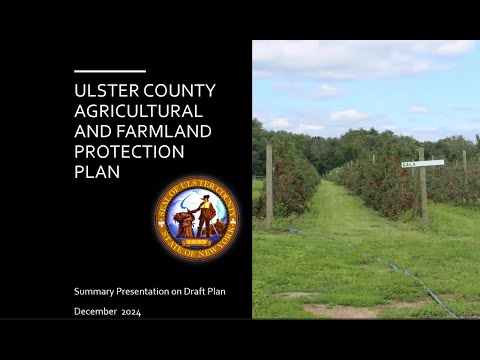
Ulster County presenters outline draft agricultural plan to protect farms, expand markets and build climate resilience
Summary
Presenters described a draft Ulster County agricultural plan that compiles local data, recommends 100+ strategies across four pillars (economic viability, land use, resilience, infrastructure), and sets a public-review and adoption timeline including a December public hearing and state review.
Speaker 1 introduced a draft Ulster County agricultural plan, saying the document compiles data and community input not available elsewhere and that "estamos definitivamente necesitábamos un plan de agricultura" to guide county decisions and preserve farmland.
The plan, presenters said, responds to long-term change in production, demographics and land use and is organized in four chapters: economic viability, agricultural lands and land use, resilience and sustainability, and supporting infrastructure such as processing and housing. Speaker 3 summarized the plan’s approach as three phases — assessing current conditions, defining a vision and goals, and identifying actions — and said the third phase offers a toolbox of potential strategies the county can pursue.
Presenters cited the U.S. 2022 Census of Agriculture data used in the plan: 486 farms in the county, roughly 73,000 acres of agricultural land (about 10% of county acreage) and about $105.5 million in agricultural product sales in 2022. "Había cuatrocientos ochenta y seis fincas," Speaker 3 said when describing the baseline data. The plan notes rising direct-to-consumer sales (about 23% of sales) and an agricultural workforce of roughly 1,800 hired workers, while also calling out that a small share of farms produce the bulk of revenue and that dairy production has declined sharply in recent years.
To address those challenges, the draft lists more than 100 strategies and highlights priorities intended for near-, medium- and long-term action. Proposed measures include a county-facing website and resource portal to centralize information; exploration of a county loan or rotating fund to help small farms expand; technical-assistance and training to increase climate-smart practices and soil-carbon sequestration; and consideration of a small-farm food hub or shared processing facilities to improve market access and enable value-added production.
Housing for farmworkers and new farmers is specifically identified as a critical need. Presenters said the plan recommends evaluating potential pilot sites for affordable farmworker housing and coordinating with municipalities on zoning and land-use tools to protect productive agricultural parcels. The draft also recommends enhanced outreach and planning education for local planning and zoning boards to make land-use decisions more compatible with modern farm operations.
Public engagement informed the draft: presenters reported two in-depth interviews, six focus groups, public and producer surveys, advisory-committee review and partner outreach via Cornell Cooperative Extension and local conservation districts. The plan webpage and partner networks were used to collect community feedback; presenters said the webpage had hundreds of visits during the outreach period.
During public comment, local business owners and residents raised operational barriers the plan could address: Stefano, owner of New Wagden (a Kingston butcher shop), told presenters that limited local slaughter and processing capacity constrains new farms’ ability to bring product to market. Attendees also asked about statistics on farmland converted to solar and about how urban agriculture fits with municipal plans; presenters said municipal plans such as Kingston’s cover some aspects of urban agriculture and that solar-conversion data were not a separate dataset in the draft.
Next steps outlined by presenters: an ongoing public comment period, a public review in December, consideration and adoption by the county legislature, and a final review by the New York State Department of Agriculture and Markets. Presenters encouraged residents and farmers to review the draft on the plan website and submit comments before the public hearing.
No formal vote or legislative action was taken during the session; presenters framed the meeting as an informational review and a public-engagement step toward eventual legislative consideration.