
Jersey Shore Area board approves ventilation upgrades and votes to close Salliesburg Elementary after heated public comment
Get AI-powered insights, summaries, and transcripts
Subscribe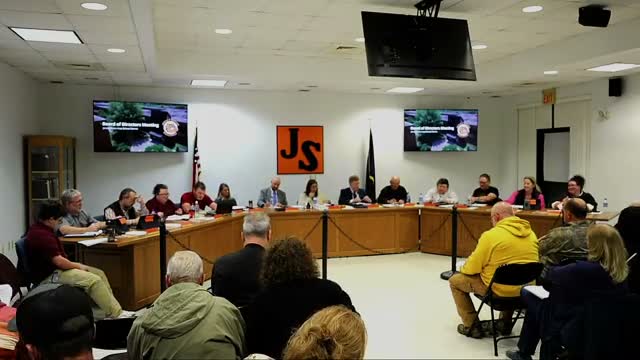
Summary
After more than two hours of public testimony, the Jersey Shore Area School District board approved a ventilation project and a motion to permanently close Salliesburg Elementary; residents warned of larger class sizes, safety and potential charter enrollment losses and pressed for clearer plans on capacity and transportation.
The Jersey Shore Area School District Board of School Directors voted Nov. 11 to approve a facilities ventilation replacement and to permanently close Salliesburg Elementary, a decision that drew more than an hour of emotional public testimony from parents, educators and residents.
Board members approved the facilities-improvement item to replace ventilation in the property maintenance shop and a high-school classroom, a project described by staff as the highest priority from the capital projects committee and tied to a facilities grant. During the finance discussion the board also adopted a reimbursement resolution designed to preserve the district's option to use future bond proceeds to cover part of the project (the resolution includes a 60-day look-back and an 18-month forward window), though no immediate borrowing was authorized.
Those measures were followed by a separate roll-call vote on the recommendation to permanently close Salliesburg Elementary. After questions from board members and public requests for more information, the motion carried by the roll call recorded by the board clerk.
Why it matters: Hundreds of residents filled the meeting to urge the board to keep small, community schools open, arguing that closing Salliesburg would increase average class sizes and strain safety, transportation and support services. Speakers repeatedly warned that consolidating students into larger elementary buildings could prompt families to enroll children in charter or cyber schools, costing the district state funding and undermining any projected savings.
Parents and community members cited district studies and numbers during public comment. Cindy Morse asked the board to clarify classroom square footage per student and said, citing the Hunt study, that Jersey Shore Elementary (JSE) was counted as having 28 regular-education classrooms and that moving all Salliesburg students to JSE would put JSE at about 109% capacity with an estimated combined population of 711 students. Multiple speakers raised the same questions: how classroom assignments and learning-support spaces would be reconfigured, whether additional lunch periods would be required and how bus routes and commute times would be affected.
Several residents invoked past closures as precedent. Ray Burley and others contrasted a 2023 capital-projects committee assessment that suggested a more limited immediate renovation need (figures in the millions) with more recent superintendent statements estimating tens of millions in required work. Residents also pointed to prior community surveys, noting that earlier responses favored keeping smaller elementary buildings open.
Board members who supported the closure said the move is part of a fiscal plan to address long-term facility needs and recurring costs. During public remarks one board member referenced projected annual savings of roughly the district's estimate (figures discussed in the meeting ranged around $840,000–$860,000), while others warned that the savings depend on multiple assumptions, including staff attrition and whether families leave for charter schools.
Representative quotes from the meeting underline the tone of the night. Anna Wall, Anthony Township, appealed to the board: “Please vote to preserve and invest in our small schools rather than throwing them away like a cheaply made appliance.” Cindy Morse asked for specific operational answers: “How much classroom space per student will JSE have after the closure?” Don Peters, referencing fiscal analysis discussed earlier, said the closure could result in “a savings of $840,000 a year,” while community members warned that increased charter enrollment could offset those savings.
Votes at a glance: the motion to approve the ventilation project was approved in a roll call (board-recorded yes votes); the motion to approve the recommendation to permanently close Salliesburg Elementary passed on a recorded roll-call vote; personnel items A–K and miscellaneous consent items were approved earlier in the meeting. The reimbursement resolution to preserve future bond reimbursement authority also passed.
What’s next: The board set implementation steps tied to the approved motions; public speakers urged the board to publish detailed plans (classroom assignments, bus-route schedules, traffic studies and precise classroom capacity calculations) and several suggested motions to revisit or postpone the closure at the board’s reorganization or subsequent meetings. Community organizers indicated they would pursue local engagement and may raise the issue in the upcoming board-election cycle.
The meeting concluded after additional courtesy-of-the-floor comments and was adjourned.