Get Full Government Meeting Transcripts, Videos, & Alerts Forever!
Get email alerts on the Education Budget topic
No spam. Unsubscribe anytime.
Board of Education asks county to back $2.5 million from fund balance; seeks safety assistants and nine elementary teachers
Summary
The St. Mary's County Board of Education budget request uses $2.5 million of fund balance (about $2.0 million for OPEB and $525,000 to balance negotiations), seeks nine elementary teachers and proposes 10 safety/security assistants; commissioners pressed the BOE on maintenance-of-effort, health insurance and class-size projections.
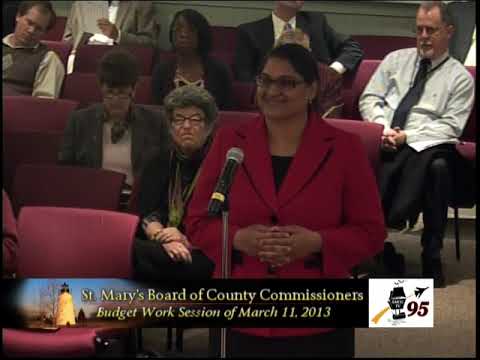
The St. Mary's County Board of Education is seeking a larger county appropriation in its FY14 budget package that includes using $2,500,000 of the school system's fund balance, Elaine Kramer, the county chief financial officer, told commissioners during a March 11 budget work session. Kramer said about $2,000,000 of that would go to the OPEB trust and roughly $525,000 would be used to cover negotiation-related balancing items.
The BOE, represented in the session, also requested funding for personnel changes the district said are needed to address student needs. Superintendent Dr. Martirano described a proposal for 10 safety and security assistants, planned primarily for elementary coverage, saying the positions should be "full time individuals under our supervision" to ensure continuity and training. Dr. Martirano noted the per-position, fully loaded cost at one point as about $34,000; however, a budget replacement page later distributed in the meeting listed a total figure of $227,550 for those assistants, an inconsistency commissioners asked staff to reconcile.
On classroom staffing, BOE officials said they want nine additional elementary teachers to meet projected student growth. The BOE explained that class-size projections for FY14 are preliminary and will be updated in May when allotments are finalized. "For right now the FY14 projections we do not update them until May," a BOE official said, noting a projected addition of roughly 260 students overall.
The session highlighted several funding pressures: the state-mandated pension shift, rising fringe and health insurance costs, and uncertainties in state revenue calculations. Kramer and BOE staff discussed the MSDE maintenance-of-effort calculations; Kramer cited an MSDE-derived county appropriation figure "about $80,400,000" as part of the calculation work. Commissioners pressed staff on the potential impact of a proposed change in the timing of income tax data (from September to November) used in wealth calculations, and on how sequestration or other state-level changes could ripple into county allocations over multiple years.
Special education needs drew sustained attention. Melissa Williams, the BOE special education representative, said the district places about 30 students in nonpublic settings statewide when specialized services are required. "We have approximately 30 children that are in non public placements," she said, and BOE staff warned that state reimbursement for nonpublic placements has fallen in recent years.
Transportation, student services and fixed charges also factored into the discussion. Jeff Thompson, director of transportation, said long runs for special-needs routes and program-based routes (Apex/Flow) create inefficiencies; the BOE is procuring special-needs contracts and experimenting with smaller buses to reduce costs.
What happens next: county staff will reconcile discrepancies called out during the session (for example the differing totals attached to the safety-assistant positions and health-insurance projection variances) and return with updated revenue and expense estimates at the next work session. Commissioners and BOE staff agreed to bring updated class-size and enrollment projections in May ahead of the June approval schedule.