Get Full Government Meeting Transcripts, Videos, & Alerts Forever!
Get email alerts on the Agriculture Planning topic
No spam. Unsubscribe anytime.
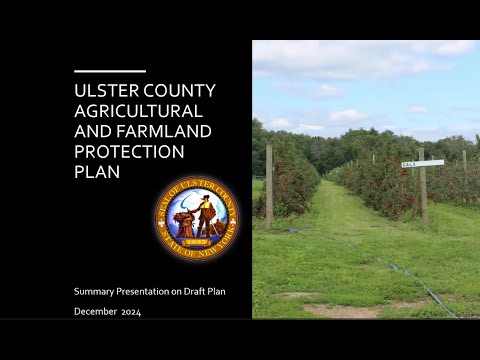
Ulster County unveils draft agricultural plan; public urges more processing, housing and implementation funding
Summary
Ulster County Planning Department presented a draft Ag & Farmland Protection Plan that updates decades-old data, maps priority farmland and lists 100+ strategies including a county loan fund, food hub study and farmworker-housing pilot. Farmers and advocates pressed for processing capacity, easier access to grants and stronger implementation resources.
A public presentation of a draft Ulster County Agricultural and Farmland Protection Plan highlighted updated maps, economic data and a set of priority actions intended to shore up farmland and support farmers.
An opening presenter called the document "an incredible thing" that assembles an "unbelievable wealth of data, maps, resources" about Ulster County agriculture and introduced Nan Stolzenberg of Community Planning Environmental Associates, who led the presentation. Stolzenberg said the county's prior plan dated to the late 20th century and that the new draft uses 2022 U.S. Department of Agriculture Census data and state Ag & Markets programs to inform planning and funding opportunities.
"The maps and the data that are in this plan is required for [farmers] to participate" in the state's Farmland Protection Implementation Grant program, Stolzenberg said, and she described an analysis that identifies priority farmland areas countywide to support easement applications and local decision-making.
The draft compiles three core elements: an assessment of current conditions, a long-term vision and goals, and a toolbox of strategies. Stolzenberg said the plan organizes more than 100 actions into four chapters: agricultural economic viability; farmland and land use; resiliency and sustainability; and supportive infrastructure. Short-term priorities included a county farm-portal website, a revolving loan fund for startups and diversification, a feasibility study for a food hub, county-level mechanisms to finance farmland protection, implementation of climate-smart practices and a farmworker-housing pilot.
Stolzenberg cited several headline numbers from the plan: 486 farms identified in the 2022 census, more than 73,000 acres in agriculture (about 10% of the county's land base), and roughly $105.5 million in agricultural product sales in 2022. She also said Ulster County ranked fourth in New York for the size of its agricultural workforce, with about 1,800 hired workers, and that 23% of farm products were sold directly to consumers through stands and farmers markets.
Farmers and local organizations used the public comment portion of the meeting to press for implementation details and infrastructure that the plan identifies as needed but does not yet deliver.
A farmer who described himself as serving in the county legislature warned growers to consult lenders before selling development rights because, he said, "once you sell your development rights, you've diminished your asset." He urged the county to explore bulk purchasing or cooperative procurement of inputs such as fuel, seed and fertilizer to lower costs for growers and recommended considering tax relief for land kept in agriculture rather than relying solely on competitive grants.
Elizabeth Ryan, a grower, called the document "an epic piece of work" but said she worried the plan may undercount recent farm losses and emphasized the county's dependence on immigrant farmworkers.
Liana Hoods of the Northeast Organic Farming Association (NOFA) New York said NOFA had not been contacted as a stakeholder and offered assistance on organic transition and climate-smart practices. She urged the county to expand the Agricultural Services coordinator role (she referenced Deborah Duane) so farmers have a single local point of contact for programs and to advance processing capacity, including meat processing. She also recommended exploring agrivoltaics (solar plus agriculture) as a way to preserve farmland while generating revenue for farmers.
"We were not contacted at all to be a stakeholder," Hoods said, and asked the county to consider a dedicated staff role to help farmers navigate programs.
Meat processor Stefano of the Meat Wagon Butcher in Kingston said local producers face a shortage of USDA-inspected processing facilities and that small businesses find grant applications difficult to use. "There's no USDA facility that does just production, let alone slaughter within Ulster County," he said, adding that new farms often lack access to processing capacity to bring product to market.
County planning staff clarified procedural points from the Zoom chat: Kristen Wilson, deputy director of planning, said the $10,000 gross-sales threshold for an agricultural assessment is set by New York State, not the county, and described how acreage thresholds affect eligibility for assessments.
On next steps, Stolzenberg said the Ag and Farmland Protection Board has completed an initial review and will meet again to consider public comments, after which the county legislature will be required to hold a public hearing under the State Environmental Quality Review (SEQR) process. If adopted by the legislature, the plan will be submitted to the New York State Department of Agriculture & Markets for review and formal correspondence of approval.
The draft plan and maps are available on the Participate Ulster website; the meeting closed with staff inviting written comments and directing questions to Bert Samuelson in the planning office.
What happens next: the advisory board will review public comments and finalize recommendations; the county legislature will schedule the required SEQR public hearing before any legislative adoption; no formal vote or adoption occurred at the meeting.