Get Full Government Meeting Transcripts, Videos, & Alerts Forever!
Get email alerts on the Town Withdrawal From County Zoning topic
No spam. Unsubscribe anytime.
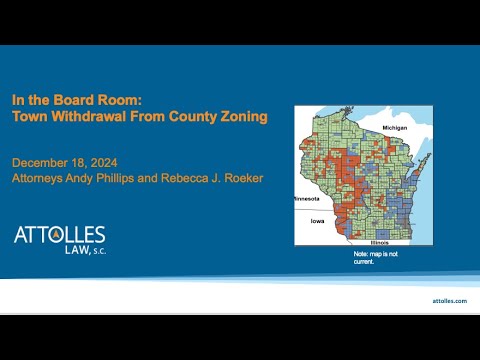
Wisconsin webinar breaks down Act 264 withdrawal process, timelines and unanswered legal questions
Summary
At a WCA webinar, Atolus Law attorney Rebecca Roker explained how Act 264 lets towns withdraw from county general zoning but prevents withdrawal from shoreland, floodplain, stormwater, and certain mining regulations; she stressed the law’s five-year delay, the required planning steps and notable implementation uncertainties.
Rebecca Roker, an attorney with Atolus Law, told county staff and officials at the WCA "In the Boardroom" webinar that Act 264 creates a specific, multi-year process by which a town may withdraw from coverage under a county’s general zoning ordinance while leaving several county controls intact. "Act 264 allows a town to withdraw from coverage of county zoning ordinance and county development at any time," Roker said during her presentation, but she emphasized the statute’s timing: the law became effective March 31, 2024, and "a town may withdraw from county zoning" no sooner than five years later, on March 31, 2029.
Why it matters: The change extends a narrow Dane County exception statewide and was designed "to foster corporate cooperation and communications between the town and the counties," Roker said. The statutory sequence requires towns to adopt a resolution of intent, to prepare and adopt a zoning ordinance enacted under section 60.62, to adopt a comprehensive plan meeting the statutory planning requirements, and to adopt an official map that satisfies the statutory standard before withdrawal becomes effective. The long lead times and required documents are intended to provide time for public education, negotiation and local planning.
What towns cannot withdraw from: Roker repeatedly noted that Act 264 does not allow a town to escape certain county regulatory authority. "A town cannot withdraw from county shoreland zoning," she said, and she added counties retain authority over floodplain zoning, stormwater management and erosion-control provisions. County rules governing quarry operations and other nonmetallic mining also continue to apply even if a town withdraws from general zoning, she said.
Uncertainties and county options: Roker identified several unresolved implementation questions counties should prepare for. The statute does not require counties and towns to communicate; "there's nothing in the statute that requires those communications," she said, which means collaboration is encouraged but not mandated. She warned that the statute does not include an explicit process for county approval of town zoning codes or for a town to rejoin county zoning, and it does not specify remedies if a town fails to complete the required statutory steps. In such cases, she said, the likely paths are litigation by affected property owners or declaratory-judgment actions seeking judicial resolution of whether a town's ordinance is legally effective.
Practical implications: Several questions from county staff focused on land-division reviews, farmland-preservation certification and shared services. Roker said that if the county’s nonmetallic-mining, stormwater or erosion-control rules are embedded within a county’s general zoning ordinance, those specific provisions still apply to towns that lack statutory authority to opt out of them. She also noted that counties are not obligated under Act 264 to assist towns that withdraw, but counties and towns can negotiate contracts or shared-service agreements for zoning administration if they choose.
Audience concerns and follow-up: Webinar attendees raised technical questions about certified survey maps, how long-term farmland-preservation agreements would be affected, whether metallic mining is covered by the nonmetallic-mining carve-out and whether a county could impose a rejoining fee; Roker answered from a legal-practice perspective in each case and flagged some answers as requiring further statutory review. She also said the presenters would follow up with clarifications (for example, on the exact statutory references for mining exceptions and farmland-preservation certification policies).
What’s next: Roker and WCA encouraged counties to use the five-year window to engage towns and residents, to clarify responsibilities and to consider intergovernmental agreements for administrative support rather than waiting for conflict or litigation. The presenters said the session materials and recording will be posted on wicounties.org and that they intend to run future sessions, including a follow-up on subdivisions and land divisions.
Ending: The webinar closed with a preview of a January 22, 2025 WCA session on lake-district questions and a final note that many practical aspects of implementing Act 264—enforcement, certification, and rejoining—remain unsettled and may be resolved only through negotiation, local agreements or litigation.