Get Full Government Meeting Transcripts, Videos, & Alerts Forever!
Get email alerts on the Community Partnership Schools topic
No spam. Unsubscribe anytime.
Children—s Home Society outlines community partnership-school model and local funding needs
Summary
Children—s Home Society told the Duval County School Board it manages 31 community partnership schools statewide and described the model—s four pillars, certification process and recurring state funding; site-level budgets and local matches for Ed White and Long Branch were detailed.
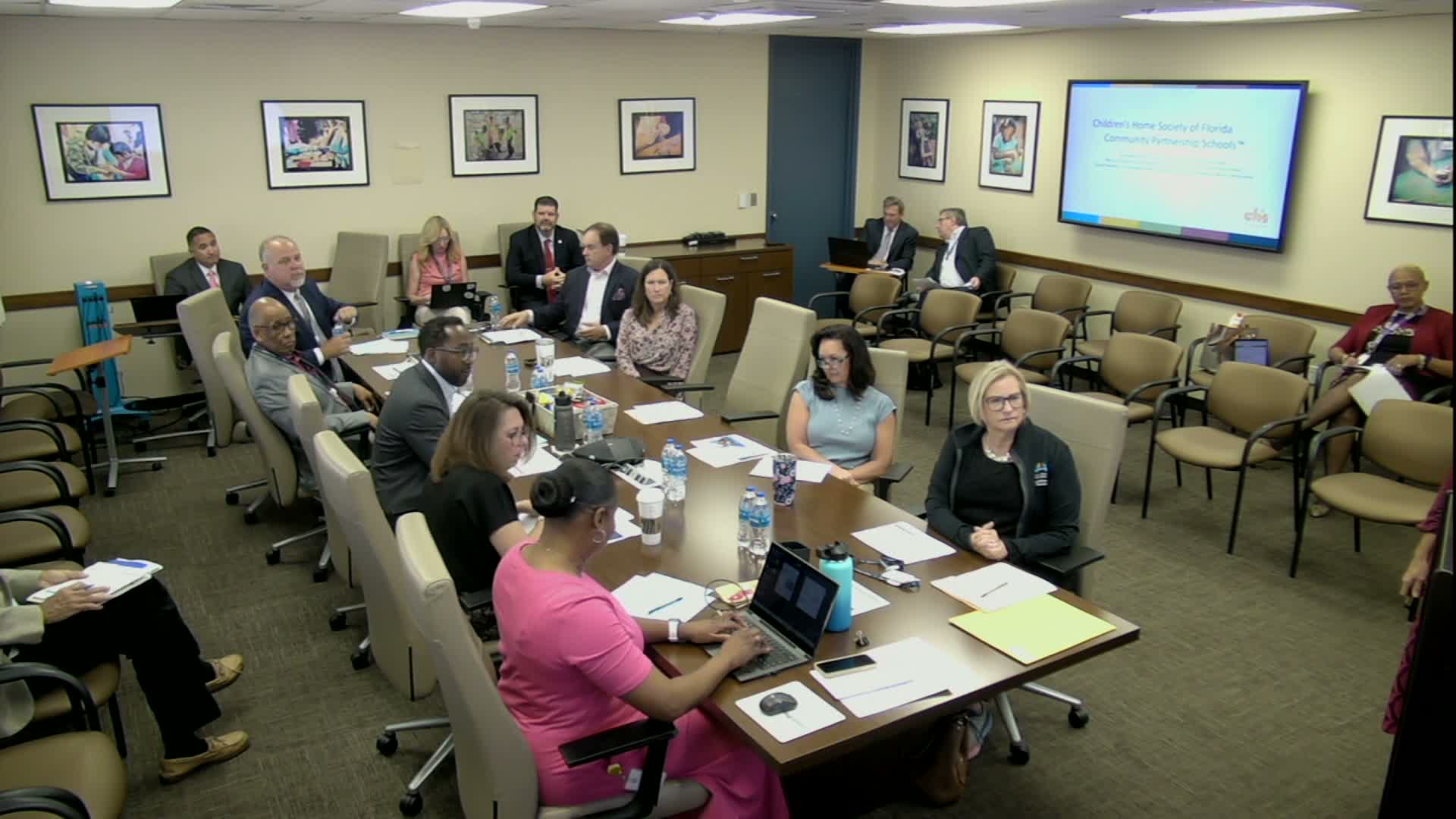
Becky Couch of the Children—s Home Society told the Duval County School Board on Oct. 8 that the community partnership school model brings a school, a local university, a health-care partner and a nonprofit together for a long-term, campus-based strategy to remove nonacademic barriers to learning. "A community school is both a physical place as well as a partnership in a school," Couch said.
Couch outlined four pillars that drive the modelcollaborative leadership, extended learning, wellness supports and daily community engagementand said the program relies on multi-year commitments from core partners. She said CHS manages 31 of the state—s roughly 43 community partnership sites and that certified sites receive five-year funding renewals after a rigorous review of standards.
At the site level, Couch gave Duval-specific figures. She said Ed White receives $442,047 per year from the state and requires a 25% local match (listed as $80,511.75). Long Branch, which received planning seed funding in its first year, will receive about $170,000 in its first implementation year and is projected to receive $391,170 in its second year of implementation when state support adds a full-time mental-health counselor.
Couch described certification as a multi-year process of strategic planning, evidence collection and peer review. "There's about 106 standards that we have to meet in order to get certified," she said, and certification unlocks recurring funding that CHS and partners use to staff clinics, family-resource centers and three core on-campus coordinators.
Board members asked about how the model varies by grade level and how partners are selected. Couch said local university partners must be community-based and provide services such as FAFSA nights, teacher training and program evaluation; health partners can be federally qualified health centers, mobile clinics or on-campus clinics staffed through partners such as Agape.
Couch said CHS had applied for six additional sites, including Matthew Gilbert, and expected state award decisions by Nov. 8. She said fundraising and in-kind match (volunteer hours, donations) are commonly used to meet local-match requirements. "We can do that through in kind or through cash match," Couch said.
The presentation concluded with board members thanking CHS for site tours and asking staff to keep the board updated on grant awards and match strategies. The board moved on to the technology portion of the workshop after the presentation.