Get Full Government Meeting Transcripts, Videos, & Alerts Forever!
Get email alerts on the Transportation topic
No spam. Unsubscribe anytime.
Duval board hears transport deep dive: routes, JTA partnership and magnet cuts considered
Summary
Operations staff briefed the board on transportation scale (28,100 trips/day, ~8M miles/year), new routing and parent apps, a JTA student‑ride partnership and three high‑level options to reduce costs including scaling back magnet transportation; staff will return with modelled savings and implementation timelines.
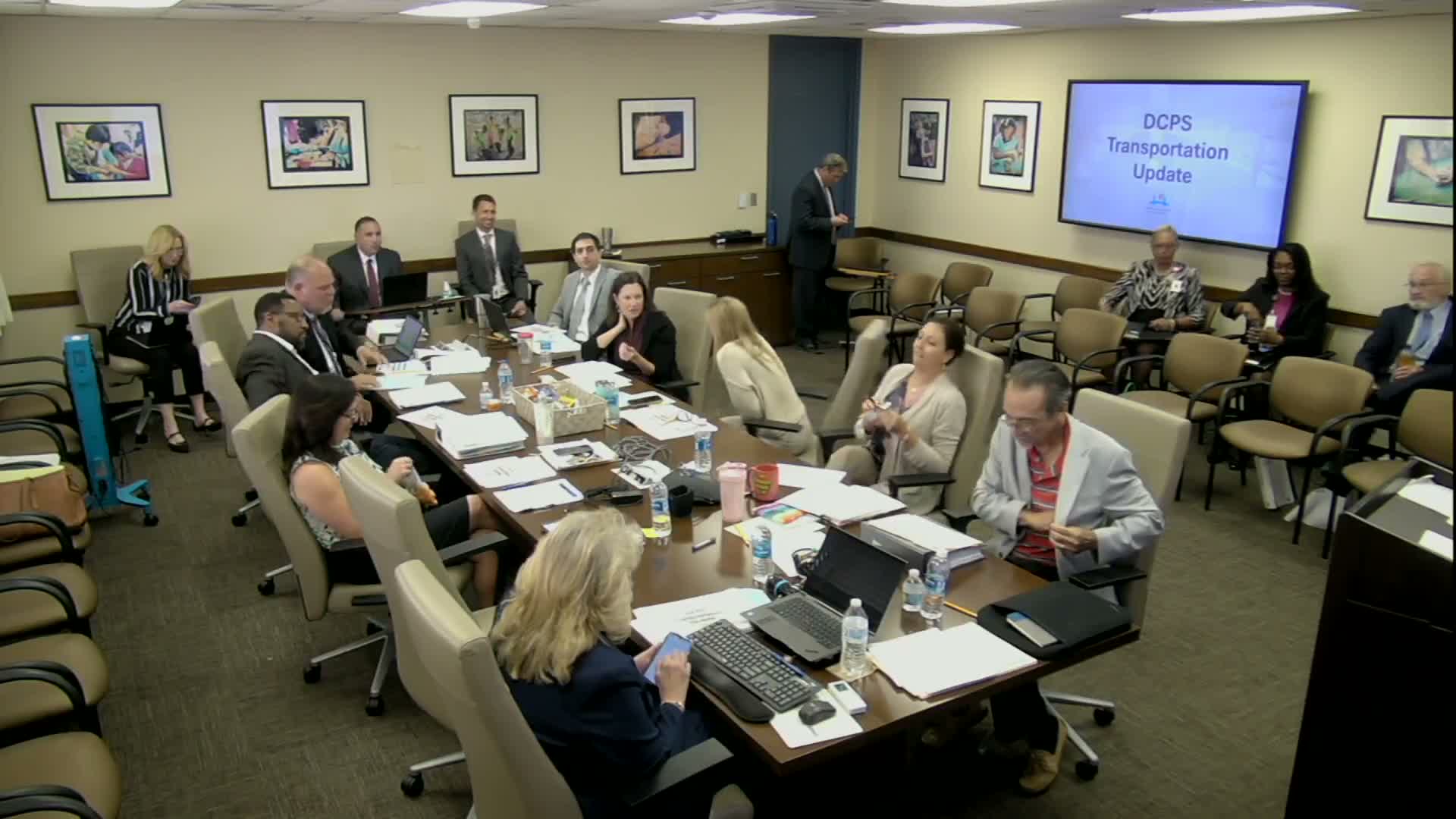
Duval County Public Schools operations staff offered a detailed workshop on Tuesday laying out the scale, cost drivers and options for reducing transportation spending.
Erica Harty, chief operations officer, said the district runs roughly 28,100 trips a day and more than 8 million miles annually. “We’re running over 28,100 trips a day,” Harty said as she described route scale and the district’s heavy reliance on contracted yellow‑bus fleets.
Staff explained new technical tools aimed at improving service and transparency: an upgraded routing system (Athena/Edulog) and a parent app integrated with the district’s single‑sign‑on. The district is piloting student smart IDs so students can tap on/off buses and families can get live location notifications in the parent portal. The board heard that 6,000 families have already signed up for the new app.
Operations also reviewed a growing partnership with Jacksonville Transportation Authority (JTA) that lets students ride JTA routes with school IDs; JTA reported millions of student boardings under a branded program. Staff cautioned, however, that JTA coverage is not citywide and some JTA routes do not match school dismissal times or the district’s operational safety features on yellow buses.
As budget pressures mount staff presented three high‑level options for potential savings: (1) eliminate certain whole‑school and school‑within‑a‑school magnet bus service, (2) eliminate all secondary magnet transportation, or (3) combine both steps to align Duval more closely with peer districts and shift some riders to public transit where practical. Staff acknowledged the tradeoffs — longer family travel, potential impacts on enrollment and athletic/extracurricular schedules, and community concerns — and proposed phased or grandfathered transitions to avoid abrupt dislocations.
Superintendent Vernier said these are preliminary considerations to start community conversations and stressed no decisions had been made. Staff will return with more detailed cost comparisons, a model of potential savings, and recommended timelines and outreach steps if the board chooses to pursue changes.
Board members asked for: school‑level estimates of affected students, deeper analysis of special‑education transportation costs, the JTA routes that could realistically substitute for district trips, and legal review of how state transportation vouchers might interact with any changes.