
Beatrice board weighs state grant to add indoor emergency maps for schools
Get AI-powered insights, summaries, and transcripts
Subscribe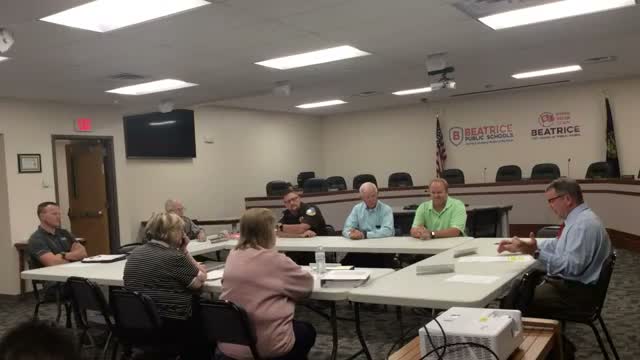
Summary
The Beatrice Public Schools board discussed applying for LB 1329 grant funding to add indoor emergency-response mapping. Local law enforcement and a security consultant urged keeping files on local servers, while some board members raised cybersecurity concerns about centralized vendor storage and remote access.
Beatrice Public Schools trustees discussed whether to apply for state funding created by LB 1329 to add indoor emergency-response mapping for district buildings, a technology district staff and local public-safety officials said could speed response in tornadoes, collapses and other large incidents.
Board members learned the grant requires the district to adopt a policy to provide mapping data to public-safety agencies. A staff member explained the proposed policy (referred to as policy 3241 in the meeting) would require the district to "provide the mapping data to the public safety agencies for use in response to emergencies" and to review the sharing annually as part of the district's emergency operations plan.
Security consultants and law-enforcement representatives who briefed the board said indoor maps can be integrated with first responders' in-vehicle computers and the local 911 CAD system. A consultant described the broader effort as "school hardening," and emphasized vendor compatibility with local systems is the primary technical question for procurement and deployment.
Trustees asked how and where maps would be stored. Presenters said the district currently uses GeoComm for 911 mapping and that indoor maps would be kept on local city/district servers with encryption and CJIS-style access controls; vendor technicians could update maps remotely when a floor plan changes. Officials said those arrangements would allow the district to push maps to Nebraska State Patrol or arriving mutual-aid units on the same platform.
Some trustees voiced cybersecurity and misuse worries about vendor-hosted, centralized repositories. One board member noted federal threat briefings and said, "Nothing online is secure, period," urging a cautious, risk-versus-reward approach before placing detailed data on vendor systems. Presenters responded that floor plans are typically public-record documents and that, while breaches happen across industries, the district had not identified any documented cases of maps being used to target schools.
Board members also discussed grant size and cost. In examples cited during the meeting, Iowa funded mapping for more than 1,700 schools; district participants estimated an initial grant award in the neighborhood of $525,000 could be available but said full coverage for every campus could run into the low millions. Staff said the district must still apply through the grant process and that specific quotes and a formal vendor estimate were pending.
The board did not take a formal vote on accepting grant terms during the transcripted portion of the meeting. Next steps discussed included obtaining formal vendor quotes, reviewing policy language (policy 3241) the board would need to adopt to receive grant funds, and coordinating further with local emergency management and dispatch on technical and access controls.
The board invited follow-up briefings and asked staff to return with vendor estimates and clarified policy language before any final action.