Get Full Government Meeting Transcripts, Videos, & Alerts Forever!
Get email alerts on the Lease Purchase topic
No spam. Unsubscribe anytime.
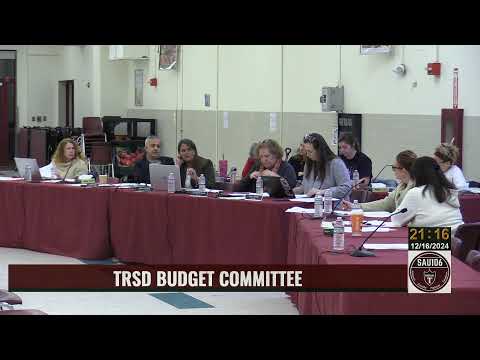
Residents and attorneys debate citizen petition to rescind Timberlane lease purchase
Summary
At a Jan. joint meeting, attorney Jim O'Shaughnessy and residents debated a citizen petition to rescind Timberlane Regional School District’s 2023 $25.243 million lease-purchase authorization. Counsel warned of equipment removal, replacement costs and legal risk if voters exercise non-appropriation; petitioners say the lease improperly avoided a two-thirds vote.
Attorney Jim O'Shaughnessy, who advised the meeting, told the joint Timberlane Regional School District budget committee and school board that the 2023 warrant article authorizing a 20-year lease-purchase up to $25,243,000 (with a first-year payment of $2,061,000) included a standard non-appropriation clause that allows the legislative body to stop appropriating funds for future lease payments. "If the legislative body at annual meeting does not appropriate sufficient funds to make the lease payment due in the coming fiscal year, then the lease will terminate," O'Shaughnessy said, explaining that termination can require the district to return equipment to the lessor.
The petition on the warrant seeks to rescind and terminate the March 14, 2023 adoption of Article 3 and would, if enacted, require the district to cease use of the leased equipment at the end of the current term (June 30, 2025) and deliver it back to the lessor at the district’s expense. "Much of the equipment is physically attached to the district such as HVAC units and light fixtures," O'Shaughnessy said. "Removing and shipping equipment and fixtures back to the lessor — how much is that gonna cost? I don't know. But removing HVAC units, air handlers, light fixtures, roofs — I was told I don't know how you return a roof." He warned the board that non-appropriation could trigger legal disputes, operational interruptions and credit implications, including potential loss of tax-exempt status on the financing interest in some scenarios.
Residents and some committee members sharply disputed the choice of a lease rather than a bond to finance facility work. "The whole premise behind this lease is trash and should have never been presented in that way," said Mister Lebreque, a member of the public, arguing that roofing and large renovations are not "equipment" and that the structure was designed to avoid a two-thirds requirement for a bond. Lebreque and others questioned whether some projects funded through the lease (they cited tennis courts and lighting) were appropriate uses of the financing.
Board members and supporters of the project said the district faced pressing facility needs — leaking roofs, aging HVAC and failing systems in multiple buildings — and that some improvements (for example, new rooftop HVAC units) reasonably require related roof or structural work. A board member responded that the 2014 legislative amendment expanded lease scope to include "building or facility improvements related to the installation, purpose or operation of such equipment," and O'Shaughnessy reiterated that the statute and the master lease contract supported such uses.
O'Shaughnessy and administration repeatedly stressed uncertainty about the practical cost and logistics if the petition were to pass: replacement procurement, legal costs, and interim operations (for example, how to keep schools open without attached HVAC equipment). He advised the group that those consequences are the factual tradeoffs voters must consider ahead of deliberative session, and he offered to provide a written legal opinion to the district before that session.
Next steps: the district and petition sponsors can discuss amendments at deliberative session; petitioners said they expected to propose clarifying language to reflect intent (they said the intent was to stop entering new contracts, not to stop payments on existing ones). O'Shaughnessy said the petition, as drafted, would be lawful but that voters should understand its practical and fiscal consequences.