Get Full Government Meeting Transcripts, Videos, & Alerts Forever!
Get email alerts on the School Funding topic
No spam. Unsubscribe anytime.
School funding experts tell Timberlane board state changes — not local cuts — are needed to fix inequities
Summary
Zach Sheehan of the New Hampshire School Funding Fairness Project told Timberlane Regional School District officials that state policy — not local budget tinkering — must change to address deep disparities driven by the statewide education property tax (SWEPT) and the adequacy formula; pending court rulings could force legislative action.
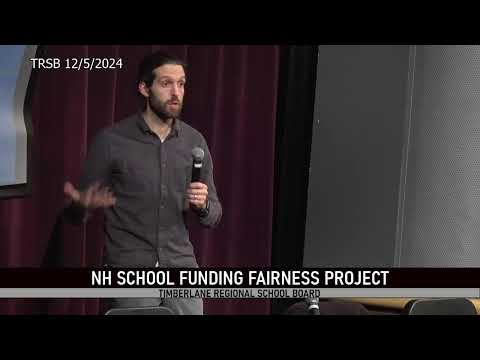
Zach Sheehan, executive director of the New Hampshire School Funding Fairness Project, told the Timberlane Regional School Board on Monday that New Hampshire’s system relies heavily on local property taxes and that recent court cases could force the state to shoulder a larger share of K–12 education costs.
Sheehan said state aid makes up a small share of total school revenue while local property taxes provide “over 60%” of school funding in the state. He described SWEPT — the statewide education property tax — as a rate that is set statewide but is currently retained locally, a feature he and litigation plaintiffs are challenging in court. “The state says, ‘here’s your 6 grand,’” Sheehan said, summarizing how the adequacy formula’s per‑student amounts are paired with SWEPT to calculate net aid.
The presentation reviewed the “adequate education” rulings that followed the Claremont litigation and the more recent ConVal/Convo and Rand cases. Sheehan said the two lawsuits seek to redefine adequacy and how SWEPT is administered, and he warned that rulings expected next spring could arrive in the middle of the state budget process. He noted that, under the current formula, many districts spend far more per pupil than the state’s stated adequacy amounts and that special‑education costs in particular outstrip the state’s share.
Sheehan used district examples to illustrate the impact of property‑wealth differences, showing that communities with higher equalized property values can raise the same dollars with much lower tax rates. He said possible legislative remedies include returning SWEPT to a true state tax, pairing a statewide tax with a homestead exemption to protect low‑value homeowners, expanding the state’s low‑ and moderate‑income property‑tax relief program, or reconsidering recently phased‑out taxes such as the interest‑and‑dividends levy.
On the legal track, Sheehan told the board that a superior‑court ruling in a Rand case found some SWEPT practices unconstitutional and that the ConVal/Convo base‑adequacy arguments were headed to the state Supreme Court. He said those decisions, if upheld, would still require the legislature to craft a statutory fix: "Courts can set floors; the legislature is the body that changes the law," Sheehan said.
During a 60‑plus minute question-and-answer session, residents and board members pressed the presenters on practical consequences: whether federal aid cuts would fall to local property taxpayers, how a restored statewide SWEPT would affect donor/recipient perceptions, and what targeted protections for vulnerable homeowners might look like. Sheehan repeatedly emphasized tradeoffs and the need for local engagement with state lawmakers.
The board received printed materials and was told the presentation and slides will be posted online. No formal board action was taken on the recommendations during the meeting; presenters encouraged community members to contact legislators and participate in upcoming advocacy and informational sessions.