Get Full Government Meeting Transcripts, Videos, & Alerts Forever!
Get email alerts on the Prime Wetlands topic
No spam. Unsubscribe anytime.
Plaistow public hearing on prime-wetland designations draws heated objections from homeowners
Summary
During a joint public hearing, residents voiced strong opposition to proposed prime-wetland designations and expanded buffers (50–100 feet), citing property impacts, potential value loss, and unclear mapping; the Planning Board will vote Dec. 18 on whether to place related zoning and warrant articles on the March ballot.
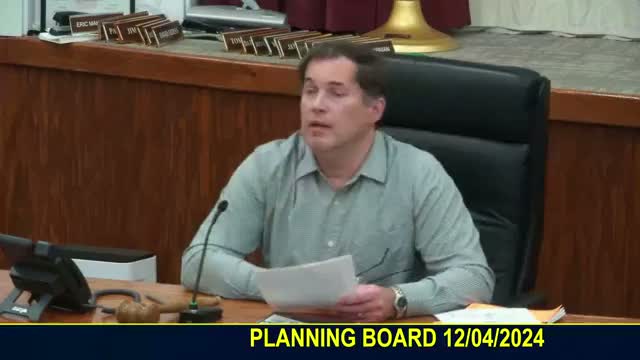
The Plaistow Planning Board and Conservation Commission held a joint public hearing Dec. 8 on proposed prime-wetland designations and corresponding increases to local buffer setbacks. The hearing featured a technical presentation by Mark West of West Environmental and extended public comment from dozens of residents who said new buffers would restrict property use and reduce home values.
Mark West, a certified wetland scientist with West Environmental, summarized the townwide wetland inventory and functional scoring process used to identify 21 candidate prime wetlands. West described methods that combined the National Wetland Inventory, LIDAR/Bridal elevation mapping and field verification and said the candidates total roughly 386 acres (about 5.6% of the town). He explained that prime-wetland impacts require higher mitigation thresholds under the Department of Environmental Services (DES) rules and that the town’s local buffer is a separate, local standard (DES regulates the wetland itself, not local buffers).
Public comment was strongly critical. Ryan Labrac (174 Main Street) described the proposal as “overreach” and urged the board to stop sending the matter to the warrant. John Zaccone Jr. of East Road and other homeowners said a proposed limited-use buffer of 50 feet (and a 100-foot structure setback) could consume their yards and limit ordinary property work; Zaccone noted a study he cited previously that estimated a roughly 4% property-value loss tied to prime-wetland proximity and asked who would compensate owners for any decrease in value. Several residents also questioned the accuracy and notice of the maps: attendees were told a tax-map overlay was prepared by cartographic associates from the mapping product and that the overlay is computer-generated and not a site survey; witnesses were told landowners may hire private wetland scientists to produce counter-mapping if they dispute the designation at the site level.
Speakers raised several recurring concerns: whether existing septic fields or homes destroyed by fire could be rebuilt in existing footprints, how repairs to septic systems would be permitted, whether home-occupancy rules would be affected, and whether the Conservation Commission had jurisdiction to affect private land use. Mark West and planning staff repeatedly explained that (a) DES approves septic-system siting; (b) existing structures are not removed by the ordinance (grandfathering applies to existing improvements) but replacements or repairs may require conditional use permits or variances if no reasonable alternative siting exists; and (c) mapping shown on the tax-map layer is illustrative and not a site survey.
Conservation commissioners said the ranking exercise aimed to give the town “teeth” to prioritize protection of the wetlands that provide the highest ecological functions after prior development controversies; they denied any motive to raise municipal revenue from permits. Several residents urged the Planning Board not to forward the prime-wetland or buffer changes to the March 2025 town warrant; the board reminded the public that the Planning Board will vote Dec. 18 on whether to post the zoning amendments and whether the prime-wetland designation should appear on the town warrant.
The hearing closed at 8:27 p.m.; the Planning Board read legal notices into the record and confirmed a December 18 public hearing where the board will consider whether to place the buffer/zoning change and a separate prime-wetland warrant article on the March ballot.