Get Full Government Meeting Transcripts, Videos, & Alerts Forever!
Get email alerts on the Municipal Budget topic
No spam. Unsubscribe anytime.
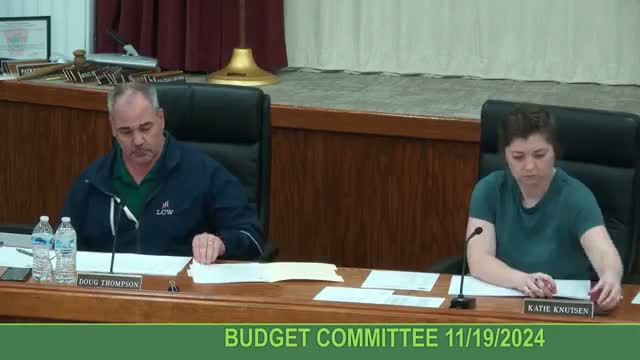
Plaistow budget committee approves recommended 2025 budgets amid debate over ambulance revenue
Summary
The Plaistow Budget Committee approved recommended fiscal 2025 budgets across departments — including police ($2,975,389), human resources ($2,556,556) and fire ($1,599,925) — and spent an extended period debating whether ambulance-service revenue (about $140,723 received through Sept.) should be treated via an enterprise fund or used now to lower the tax rate.
The Plaistow Budget Committee met and approved the town’s recommended fiscal 2025 department budgets, including major spending for police, human resources and fire services, while members weighed how to account for ambulance-service revenue collected so far.
The committee adopted a slate of budgets as presented by staff: the police department at $2,975,389, human resources/personnel at $2,556,556, and the fire department at $1,599,925. Many other department budgets were approved in sequence by motion and voice vote, with occasional abstentions noted during planning and recreation votes.
Committee members spent the meeting considering both line-item changes and broader policy questions. Staff emphasized salary-driven increases across multiple departments to cover anticipated retirements and newly authorized positions. On the election budget, officials noted a planned purchase of new voting machines (roughly $6,000 each) with an anticipated 50% state buyback to offset cost.
The most extended discussion centered on the ambulance service and how to use its realized revenue. Staff presented an ambulance revenue/expenditure analysis showing approximately $140,723 collected through the end of September. One committee member urged using realized ambulance revenue to reduce the budget presented to taxpayers: “This $200,000 we know that came in, we're taking $200,000 out,” the member said, arguing for a direct offset to the tax-rate calculation.
Town staff strongly cautioned against immediately moving ambulance receipts to a separate enterprise account, citing accounting and operational complexity. A staff member said, “If we follow that logic... we would still leave $200,000 in this budget to fund the shortfall,” and later characterized the ambulance operation as a beginning-stage, “loss leader” that is not yet self-sufficient: “The ambulance right now is a loss leader.” Staff also offered to provide detailed records in person to demonstrate current accounting practice: “If you wanna come into my office, I will sit down with all of those forms and show you exactly how it is.”
Despite the debate, the committee approved the fire budget and related personnel decision motions by voice vote. Members agreed to revisit structural accounting questions around enterprise funds and the ambulance service as more monthly revenue data accumulates and operational accounting matures.
Votes at a glance (selected major items) — all outcomes reflect motions, seconds and voice votes recorded during the meeting: • Executive budget — $282,684 — approved (motion by Speaker 4; second Speaker 7). • Human resources/personnel — $2,556,556 — approved (motion by Speaker 4; seconded). • Police department — $2,975,389 — approved (motion by Speaker 4; seconded). • Fire department — $1,599,925 — approved (motion; seconded). Extended discussion on ambulance revenues followed; no separate formal vote on enterprise conversion. • Planning (impact fee update) — $114,120 — approved with one abstention recorded.
Next steps and context: the library budget is finalized and the water department budget is scheduled to be presented at the next meeting; the Budget Committee adjourned at 7:47 p.m. and plans to reconvene in early December to complete remaining items.
The reporting above is based solely on the committee’s public discussion and motions as recorded in the meeting transcript; no outside documents were used.