Get Full Government Meeting Transcripts, Videos, & Alerts Forever!
Get email alerts on the Ambulance Billing topic
No spam. Unsubscribe anytime.
Plaistow fire chief: town-run ambulance service beginning to meet revenue expectations as collections rise
Summary
Fire Chief Chris Knutsen told the Plaistow Budget Committee that the town'run ambulance service, launched March 1, is now generating sustained collections after initial months of delay; the committee pressed for receivable detail and a collections policy before deciding whether to pursue balances from residents.
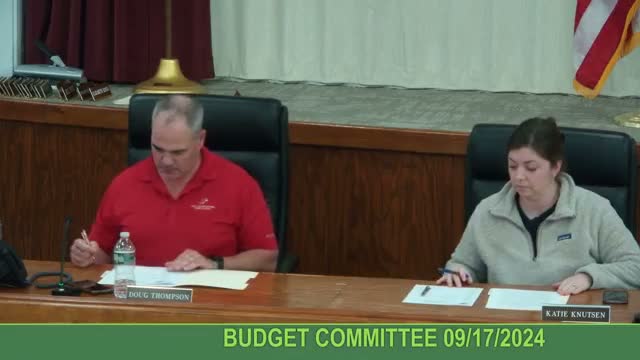
Plaistow Fire Chief Chris Knutsen told the Budget Committee on Tuesday that the town'run ambulance program, which began operations on March 1, is seeing rising collections and is approaching the monthly revenue needed to meet the service's budget projection. "We actually started March 1st," Knutsen said, and "we've made a tremendous impact to the community already."
The committee pressed Knutsen on how billed charges translate into cash. Knutsen described industry terms for the hearing: the "billed amount" is what the town charges; the "adjusted" amount reflects insurer fee schedules (largely Medicare and Medicaid) and cannot be collected; amounts more than 90 days past due are considered "delinquent" and may eventually be purged. "Anything over 90 days would be considered delinquent," he said.
Why it matters: the town used a projected annual revenue figure of about $400,000 when weighing the change from a contracted provider to an in-house ambulance service. The pace at which the town converts billed charges into collections will determine whether the service offsets its operating cost, whether the town adopts a policy to pursue patient balances, and how the service appears in the municipal budget presented this fall.
Details from the committee exchange: Knutsen said the billing company and outside firms advised that reliable collections typically appear after 6'9 months; he reported noticeable inflows in recent months. He gave month-by-month examples the committee discussed: June collections rose into the mid-'20,000s, July collections were roughly $35,000, and August collections ran in the upper-'20,000s, figures that are approaching the roughly $33,000-per-month pace the town used to estimate the $400,000 projection. Knutsen also said the billing company retains a 4% fee on collections and that roughly 60'70% of transports involve Medicare or Medicaid patients, which produces a significant adjusted (non-collectible) portion of billed charges.
Knutsen explained how charges are structured: four flat-rate base charges by level of treatment plus a per-loaded-mile fee. As an example from an itemized report he showed the committee, a base charge of about $1,800 plus mileage at $45 per mile produced an illustrative call charge in the low thousands (example figures were presented by Knutsen as part of the billing company's call detail). He cautioned the committee that insurer fee schedules determine final payments and that many claims are resolved 60—20 days after submission.
The committee asked for more transparency in the receivables. Members referenced the billing company's aging report and asked for a consolidated year-to-date roll-up (March through the latest month) and the August numbers; Knutsen said those data exist in the billing company's reports and that he would help obtain a clearer roll-up for the committee and for the upcoming budget review. He reported that the ambulance service has transported 369 patients since March 1 and estimated roughly 65% of calls originate at residential addresses.
On policy choices, Knutsen said the town must adopt a single, consistent approach to collections and balance billing if it chooses to pursue unpaid patient balances; he noted many municipalities do not place liens for ambulance charges and emphasized avoiding practices that would discourage people from calling 911. He recommended waiting for more months of collections data (billing consultants advised about nine months) before finalizing a collections policy and any resident billing program.
Next steps: the committee asked staff to circulate a year-to-date revenue roll-up and to provide August figures. Knutsen is expected to appear when the town submits the proposed budget to the board of selectmen so the committee can review the ambulance program as part of the formal budget process.