
Insurance commissioner details industry size, claims handling and staffing shortfalls
Get AI-powered insights, summaries, and transcripts
Subscribe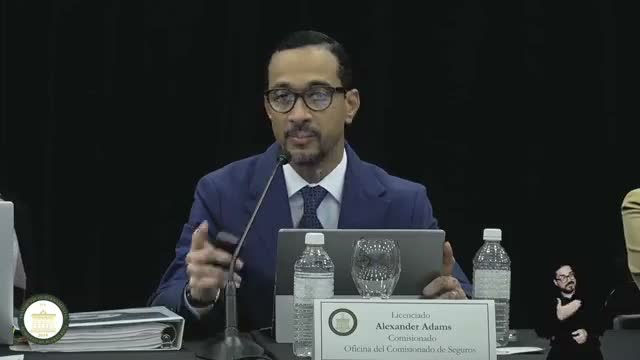
Summary
Lic. Alexander (Comisionado de Seguros) told the transition committee the office recovered NAIC accreditation in 2022, handles roughly 70 formal complaints per year, and identified staffing and budget constraints while reporting $7.5 billion paid for Hurricane María claims and $242.6 million in unpaid health-sector obligations found in audits.
Lic. Alexander Als Vega, the commissioner of insurance, told the Transition 2024–2025 committee on Dec. 6 that the Office of the Commissioner of Insurance regulates Puerto Rico’s insurance market and has taken several steps to modernize oversight while confronting staffing, budget and legal limits.
The commissioner said the insurance industry accounted for 17.4% of Puerto Rico’s gross domestic product in 2023 and that companies wrote about $20.5 billion in premiums that year. He reported the office currently has 75 employees — “setenta y cinco empleados” — split between 17 trust positions and 58 career staff and said the agency’s approved budget for the fiscal year covers payroll, operations and pay‑go at $13,092,000.
Why this matters: the office oversees a large financial sector and faces technical recruiting gaps in actuarial, financial analysis and exam divisions that the commissioner said impede timely regulatory work. “Para atraer personal… hemos realizado sesenta y siete convocatorias,” he said, and recommended reviewing pay scales in technical units.
The commissioner summarized the office’s work on catastrophe claims. He said insurers received about 303,956 claims after Hurricane María and that private insurers had paid roughly $7.5 billion as of June 30, 2024, with “el noventa y nueve punto siete de las reclamaciones habían sido atendidas.” On earthquake claims he reported 25,473 claims and $361 million paid as of the same date, with 99.8% of claims attended.
Audits and outstanding provider payments: citing special audits of the health sector, the commissioner said the office identified $242.6 million in outstanding payments to health‑care providers across segments including Advantage, Vital and commercial plans. He attributed the figure to targeted fiscalization efforts and said the office pursued further audit rounds that prompted litigation by industry groups. “Fuimos demandados y llevado al a un pleito federal,” he said, and confirmed the litigation remains pending.
Consumer tools and process changes: the commissioner outlined several consumer‑facing changes implemented during his term. His office created a centralized credentialing portal (referred in the presentation as Zyro) to streamline provider credentialing, introduced a digital complaints platform and a specialized denial‑appeal tool called “alert plus,” and adopted cybersecurity testing and incident‑notification mechanisms for companies. He said the office adjusted regulation to permit parametric insurance mechanisms and proposed provisional, expedited certificates of authority to accelerate International Insurance Center growth.
Inspector General report and timeliness: committee members raised an Office of Inspector General (OIG) report that sampled investigation timings and found wide variation (from 1 to 476 days), with more than 31% taking over 180 days. Commissioner Alexander acknowledged the OIG findings but said some adjudicative pauses were counted in the OIG sample and that the office filed a corrective‑action plan. He agreed to provide the committee the office’s remediation materials and investigative files where appropriate.
Jurisdictional limits and enforcement: the commissioner clarified jurisdictional boundaries: commercial private plans are regulated by the Office of the Commissioner of Insurance; Vital plans are handled by ASEX (administración de seguros) and Medicare Advantage falls under CMS. He said this division limits the office’s reach over Advantage plans and that attempts to audit Advantage plans led to legal challenges. He urged national coordination through the National Association of Insurance Commissioners to pursue greater authority for state and territorial regulators.
Documentation requests and next steps: committee members requested lists of pending court cases and outstanding claims; the commissioner agreed to provide records and said the office would supply the investigative file and corrective‑action documentation requested. He recommended legislative review of unfinished measures (including proposals to give the office remedial payment authority) to strengthen remedies available to insureds and claimants.
The committee moved to questions on other items after the commissioner completed his presentation; no formal motions or votes were taken during this session.