Get Full Government Meeting Transcripts, Videos, & Alerts Forever!
Get email alerts on the Legislation Committee Referral topic
No spam. Unsubscribe anytime.
House committee advances two measures on elder financial protections and prison rehab but lacks quorum; texts sent to same-day referendum
Summary
The House Committee on Social Welfare, Persons with Disabilities and Older Adults considered a Cámara bill to strengthen protections against financial exploitation of older and disabled adults and a Senate bill to authorize therapeutic-community rehabilitation in correctional facilities; lacking quorum, the committee sent the amended texts to a referendum scheduled for 4:00 p.m. the same day.
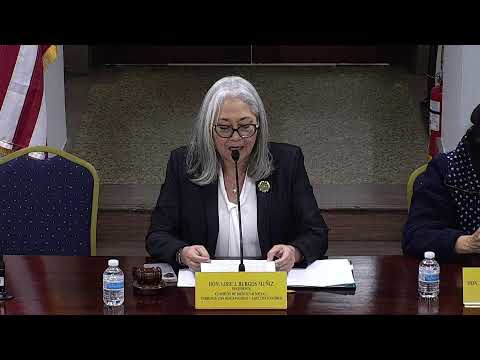
The public final-consideration session of the House Committee on Social Welfare, Persons with Disabilities and Older Adults opened June 23, 2024 at 3:32 p.m. to consider two measures: a Cámara project described in the record as aiming to amend law 206 of 2008 (and related provisions) to prevent and detect possible financial exploitation of older adults and persons with disabilities, and Senate Project 54 to authorize implementation of a therapeutic-community rehabilitation model inside correctional institutions.
The committee president, identified in the transcript only by role, summarized the Cámara measure as seeking “insertar a la defensoría de las personas con impedimento en la ejecución de la política pública de protección contra la explotación financiera” and to require review and updating of implementing regulations and plans, including references to law 57 of 2009. On the Senate proposal, she said the measure would permit the Secretary of the Department of Correction and Rehabilitation to implement the therapeutic-community model “para atender a los confinados y a las confinadas con problemas de abuso y adicción de sustancias controladas.”
Griselly Ortiz Pizarro, recorded on the record as directora, told the committee the projects and the circulated amendments had been distributed to members at 1:30 p.m. that day and proceeded with a formal reading of the circulated amendments. The president cited section 12.21 of the House rules to explain that this public final-consideration session exists for amendment and advocacy on proposed amendments and is not the floor debate that occurs when measures are presented on the calendar of special orders.
When the committee attempted to verify quorum, the director reported the body did not have the required number of members present. The president invoked section 12.21.E and section 12.16 of the House rules and submitted the amended texts to a vote by referendum because a quorum was not present. She set the referendum for later that afternoon at 4:00 p.m. The record shows no formal roll-call vote in the session itself; the action taken during the meeting was procedural: to send the amended texts to a same-day referendum and to adjourn.
The meeting concluded at 3:39 p.m. with no additional matters pending. The committee’s next procedural step recorded in the session was the scheduled referendum at 4:00 p.m. to continue consideration of the amended measures.