Get Full Government Meeting Transcripts, Videos, & Alerts Forever!
Get email alerts on the Climate Resilience Metrics topic
No spam. Unsubscribe anytime.
Massachusetts seeks public input on draft climate resilience metrics to track state progress
Summary
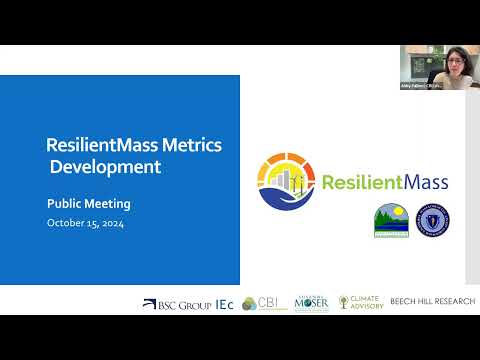
The Executive Office of Energy and Environmental Affairs invited public and stakeholder input on a draft set of about 30 climate resilience metrics intended to measure state actions and outcomes; a small subset will appear in the annual climate report card later this year.
Katharine Ann Thompson, undersecretary for decarbonization and resilience at the Executive Office of Energy and Environmental Affairs, told attendees the state is developing climate resilience metrics "for Massachusetts" to measure where the state is "ahead" and where it is "falling behind" and to help prioritize programs and spending.
The virtual meeting, described by organizers as the second and final public session for this phase, reviewed the project’s purpose, the categories of proposed indicators, and a plan to narrow a long list of possibilities to roughly 30 implementable metrics across eight sectors. Jackie Willworth of Industrial Economics, the consultant supporting the state, told participants metrics serve multiple purposes — communication, planning, accountability and learning — and described a structure of goals, indicators and metrics. Organizers emphasized a central environmental justice, equity and collaboration sector to ensure progress is tracked for priority populations, including environmental justice communities and tribal nations.
Project staff and consultants described a three‑tier approach to data availability: a green row of metrics with data ready now, a yellow row for metrics with partial data that could be implemented in the near term, and a blue row for longer‑term ideas where the state lacks the necessary data or processes. Maya Nancy, introduced by the undersecretary as the project manager and assistant secretary for resilience, said the team is not setting uniform targets across all metrics at this time, though "where there are targets, those often come from current initiatives." The group also said some metrics will be reported in the annual climate report card — with a smaller subset expected to appear this December — while a broader set will be published later via an online dashboard.
Organizers asked participants to join one 45‑minute breakout to prioritize metrics for a chosen sector and to participate in online polls that will remain open through the evening. Abby Fulham of the Consensus Building Institute explained participants will rate metrics by data availability and usefulness, then share why they prioritized particular measures. The team plans to use breakout input and advisory‑group review to finalize an initial metric list, confirm baselines with agency partners in November, and prepare implementation recommendations in December.
No formal votes or policy decisions were taken at the meeting; the session focused on stakeholder input and next steps. Emily Dahl, named earlier by staff as a co‑project manager, thanked participants for their time and said the project team will follow up by email with poll links and additional materials.
The meeting materials and action tracker for the Resilient Mass Plan were cited as sources of existing strategies and will feed into metric selection; FEMA was noted as having approved the Resilient Mass Plan, which the presenters described as a framework guiding this metrics effort. Organizers encouraged participants to continue to provide feedback through the open polls and forthcoming agency consultations as the state moves toward baselining and reporting on the selected resilience metrics.